
The treasury function has transcended back-office task as businesses today face the challenges of financial volatility, global operations and digital transformation thus evolving into power centres. Today, organizations often need to manage liquidity, mitigate risk, optimize cash flow and ensure regulatory compliance across geographies and currencies. This complexity would bring the use of automated treasury management systems.
The automated treasury management system would no longer be a luxury for bigger firms but it is fast becoming a necessity for firms that are after real-time financial visibility, greater efficiency and stronger risk controls. As a result, knowing how and why it would matter would help an organization to modernize their treasury operations.
What Is Automated Treasury Management?
Using programs to run a treasury department is what automated treasury management is all about. The central systems will replace manual spreadsheets and disconnected tools so as to create a unified platform enabling integration of banking & ERP systems, forecasting models and risk management tools.
The treasury teams were to largely depend on manual oversight for cash position monitoring, payment initiation, bank account reconciliation and risk management. The tasks would take excessive time and prone errors. Using automation, real-time data integration and analytics to improve accuracy and decision making, the automated treasury management would eliminate recurring manual tasks.
Why Businesses Are Moving Toward Automation
Present day businesses would be operating in a fast-paced environment where financial decisions have to be made quickly and accurately. The manual treasury processes would create delays, increase operational risk and limit visibility into cash positions.
Such challenges would be addressed by automated treasury management by providing centralized control over liquidity and financial operations. It would ensure that finance leaders would have immediate access to real-time data thus enabling faster and more informed strategic decisions. Moreover, automation would strengthen internal controls, reduce fraud risks and would enhance compliance with regulatory requirements.
Managing multiple bank accounts, currencies and payment channels would become more complex as companies expand globally. The automated treasury management would simplify this complexity by consolidating operations into a unified system.
Key Components of Automated Treasury Management
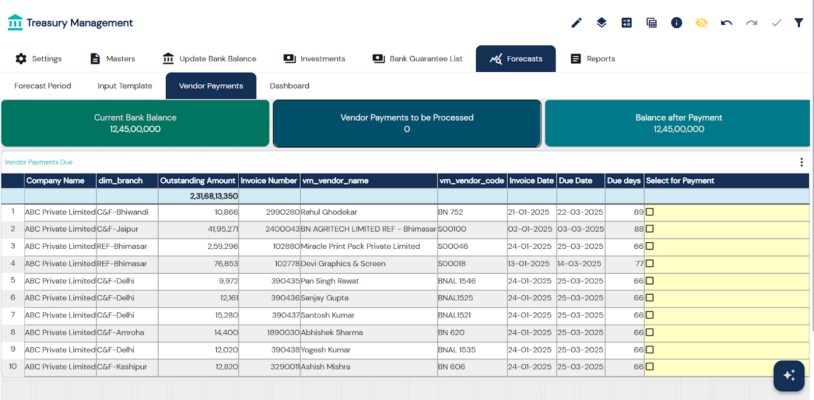
1. Cash and Liquidity Management
Real-time cash management is one of the key functions of automated treasury management. The system would consolidate balances from multiple bank accounts and subsidiaries into a centralized dashboard. This would enable treasury teams to monitor liquidity positions accurately and allocate funds effectively.
The automated treasury management with its improved visibility would support better cash forecasting, reduce idle cash balances and help organization optimize their working capital
2. Payment Automation
The risk of duplication, fraud and processing delays would be more when payments are managed manually. The automated treasury management would streamline payment workflows by integrating with banking systems and by automating approvals.
The system would initiate domestic and international payments, apply authorization controls and maintain detailed audit trails. This would not only enhance efficiency but would also strengthen governance.
3. Bank Reconciliation and Connectivity
Automated treasury management would directly integrate with banks to retrieve transaction data in real time. This connectivity would simplify reconciliation process and would ensure that discrepancies would be identified quickly.
The treasury teams can reduce their manual workload while improving financial accuracy by automating transaction matching and reporting.
4. Risk Management
The treasury teams would be in charge of managing foreign exchange, interest rate and credit risks associated with businesses. A treasury management system that is automated would offer analytical tools which would monitor and mitigate these risks.
The finance leaders could leverage real-time dashboards and scenario modelling to assess potential risk exposure and take hedging actions.
5. Financial Reporting and Compliance
The finance team’s top concern is regulatory compliance. The automated treasury management system would simplify reporting by producing accurate, standardized financial reports.
The built-in audit trails could keep track of every transaction and approval, thus ensuring transparency and compliance with internal policies and external regulations.
Benefits of Automated Treasury Management
The transition to automated treasury management delivers significant operational and strategic advantages:
- Improved Efficiency: Eliminates repetitive manual tasks, allowing treasury teams to focus on strategic initiatives such as investment planning and risk analysis.
- Greater Accuracy: The organization can demonstrate greater accuracy by reducing spreadsheet errors and applying the same matching rules and checks to data.
- Enhanced Visibility: Bigger picture visibility of your cash position, outstanding payments and financial exposure through real-time dashboards thus enabling better forecasting and decision-making
- Stronger Internal Controls: Creating stronger internal controls that would require a role-based access for every user, with workflow of approvals and audit trails to protect against fraud and unauthorized transactions
- Scalability: As your business would increase transactions, it can handle it without increasing headcount by the same rate
Challenges of Manual Treasury Processes
The organizations that would continue relying in manual treasury operations would often face several challenges. The systems would suffer from multiple disintegrated data fragmentation, slow reporting, high operational costs and an increased chance of errors.
The manual processes would also limit the strategic insight. Without access to such consolidated real-time data, finance leaders will not get a complete picture of liquidity and risk exposure. Delay in decision making would affect overall profitability of the project.
These inefficiencies would be resolved by automated treasury management by centralizing operations and enabling data -driven strategies.
How to Implement Automated Treasury Management
The successful implementation would begin with assessing current treasury processes. The organizations should identify inefficiencies, pain points and areas prone to errors. By selecting the right automated treasury management platform and would require evaluating integrating capabilities, scalability, security features and reporting tools.
The integration with existing ERP and banking systems would be critical for seamless data flow. Moreover, businesses would establish clear governance policies and provide adequate training to treasury staff to ensure smooth adoption.
The change management would be equally important. Therefore, transitioning from manual to automated treasury management would require process reengineering and stakeholder alignment to maximize benefits.
The Future of Treasury Automation
In the future, technologies like AI and predictive analytics will see higher adoption in automated treasury management. AI forecasting models will smartly take advantage of historical data that will improve cash flow prediction accuracy. With algorithms detecting outliers, we’ll be able to detect fraud in real-time.
Flexible cloud-based platforms would also become more common thus allowing for scalable access from anywhere, securely. Automated treasury management would continue to evolve thus enabling finance teams to operate with greater agility and precision as digital transformation would accelerate.
Conclusion
Treasury management would become an important strategic function that would directly influence business stability and growth. Manual processes would be no longer sufficient in a world of financial complexity and rapid change. The treasury management automation will provide organizations real-time visibility, greater accuracy, improved risk control and scalable operations.
When treasury functions are centralized and automated, businesses will be able to reposition their finance departments from reactive support functions to proactive strategic partners. As such, any investment decision with regard to an automated treasury management suite must not only enhance efficiency but also build resiliency, drive smarter decision making and position the organization for success in a rapidly evolving economic environment.
