

In present day financial environment which is complex, maintaining accuracy in financial records would be no longer optional but essential. Businesses would need to handle a high volume of daily transactions, ranging from vendor payments and customer receipts to payroll and tax remittances. For financial stability of organization, it is very important to ensure that these transactions are accurately recorded and aligned with bank statements. This is where a good bank reconciliations solution would play a transformative role.
Bank reconciliations is not just an accounting formality but a vital internal control mechanism that would protect organizations from fraud, would prevent financial misstatement and would strengthen cash flow visibility. The companies can improve their operational efficiency while enhancing financial transparency by following structured best practices and implementing a strong bank reconciliation.
Understanding Bank Reconciliation
Bank reconciliation is a process where the company’s financial records would be compared with its bank statements to identify discrepancies and ensure consistency. The differences found in the process would arise due to timing gaps, unrecorded transactions, bank charges, interest income, duplicate entries or even unauthorized activities.
While conventional reconciliation depended heavily on spreadsheets and manual verification, modern finance teams would depend more on automated bank reconciliation solution platforms. These systems would reduce human intervention and would significantly improve accuracy and speed.
The Importance of Strong Reconciliation Practices
The quality of financial reporting is directly impacted by accurate reconciliations. When discrepancies would go unnoticed, they could distort financial statement, misrepresent cash position and affect business decisions. The timely reconciliations would ensure that the errors would be detected early thus reducing the risk of financial mismanagement.
Additionally, reconciliation would strengthen fraud detection. Unusual transactions, duplicate payments or unauthorized withdrawals would be quickly identified when records would be systematically compared. A structured bank reconciliation would enhance this oversight by automatically flagging mismatches and irregularities.
Best Practices for Effective Bank Reconciliation
Perform Reconciliation Frequently
Consistency is one of the important best practices of bank reconciliation. Businesses should reconcile accounts regularly rather than waiting till month end. The reconciliation could be weekly or even daily for high-volume operations. The frequent reconciliations would prevent backlog accumulation and would allow discrepancies to be addressed promptly.
The organizations would be able to schedule recurring reconciliation cycles and ensure that the processes would become a standardized routine rather than a quick monthly task with the help of bank reconciliation solution.
Leverage Automation for Accuracy
The manual reconciliation would be both time-consuming and error-prone. Even minor data entry could lead to significant discrepancies. The automation would eliminate repetitive manual matching and would accelerate the entire process.
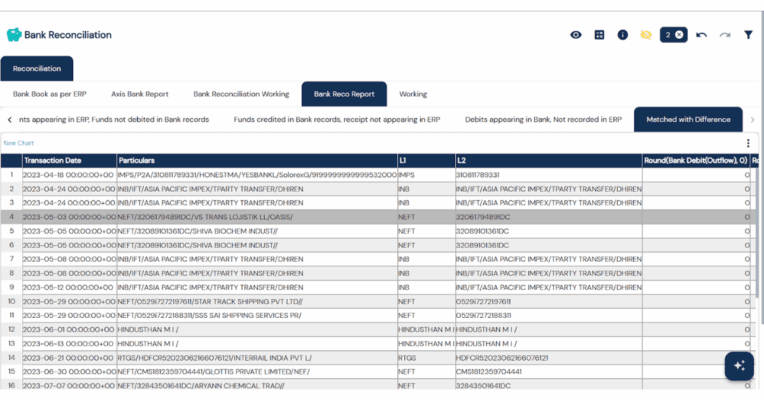
A modern bank reconciliation solution would automatically import bank statements; match transactions based on predefined rules and would highlight unmatched items for review. This would not improve efficiency but would also allow finance professionals to focus on analysis and strategic planning instead of manual comparisons.
Establish Clear Policies and Controls
A well- defined reconciliation policy would ensure consistency and accountability. The organizations should outline who is responsible for reconciliation, the approval process and the timeline for completion. The clear documentation standards should also be established to support audit requirements.
Embedding these policies into a bank reconciliation solution would help standardize workflows. A role-based access controls and automated approval hierarchies would reinforce accountability and reduce operational risks.
Ensure Segregation of Duties
Segregation of duties is a critical internal control measure. The individual responsible for recording transactions should not be the same person who would perform reconciliation. This separation would reduce the risk of intentional manipulation or concealment of errors.
An advanced bank reconciliation solution platform would support this best practice by assigning specific user roles and restricting access based on responsibilities. Such structured access control would strengthen overall governance.
Investigate Discrepancies Promptly
If unresolved discrepancies would be ignored, they could escalate into larger financial issues. When mismatches would be detected, finance teams should immediately review supporting documentation, verify entries and communicate with the bank if necessary. The adjustments should be documented clearly to maintain transparency.
A reliable bank reconciliations solution would provide an audit trail that would track when discrepancies would be identified, who reviewed them and how were they resolved. The visibility would be invaluable during internal reviews and external audits.
Reconcile All Financial Accounts
The organizations would often focus only on primary operating accounts, overlooking smaller or secondary accounts. However, every account would include payroll, credit card, petty cash and foreign currency accounts that should be reconciled regularly.
Using a centralized bank reconciliation solution ensures that all accounts are managed within a single platform. This comprehensive approach reduces oversight risks and improves financial accuracy across the organization.
Maintain Organized Documentation
Proper documentation would support audit readiness and regulatory compliance. Each reconciliation cycle should include supporting bank statements, ledger reports, reconciliation summaries and documentation of adjustments.
Cloud-based bank reconciliation solution systems would securely store these records and make retrieval easy. This would eliminate the stress of last-minute audit preparation and ensures compliance with financial reporting standards.
Integrate Systems for Real-Time Visibility
Real-time integration between ERP systems and banking platforms would significantly improve reconciliation efficiency. When transaction data would flow automatically into the reconciliation system, delays and manual uploads will be minimized.
An integrated bank reconciliation solution would enhance cash flow visibility and support more accurate financial forecasting. Finance leaders would gain immediate insights into liquidity positions and outstanding transactions thus enabling better decision-making.
Monitor Reconciliation Performance
Performance monitoring would require continuous improvement. The finance teams should evaluate how long reconciliation cycles would take, the volume of unresolved transactions and recurring error patterns.
Many modern bank reconciliation solution platforms would provide dashboards and analytics tools that would help track these metrics. Assessing patterns would allow organizations to improve processes and remove inefficiencies over time
The Limitations of Manual Reconciliation
Manual methods of reconciliation may be effective for small businesses with low transaction volumes, but they would become less efficient as companies would grow. Spreadsheet procedures would lead to formula problems, versioning errors and duplication of data. These would not have centralized visibility or audit trails.
As transactions would become more convoluted, organizations would expose themselves to financial and compliance risks with only manual methods. The challenges could be resolved with the implementation of a bank reconciliation solution that could further aid scalability.
Conclusion
Bank reconciliation is a foundational financial control that would ensure accuracy, transparency and compliance. If undertaken in a systematic manner and enabled by automation, this would not just be a mere accounting exercise but a strategic advantage.
Businesses can improve financial reliability by adopting best practices such as frequent reconciliation, automation, segregation of duties, documentation and system integration among other practices. A modern bank reconciliation solution increases efficiency, limits error rates, enhances internal controls and supports audit readiness.
More or less in the latest data-driven business landscape, investing in the correct bank reconciliation solution would be about more than just accounting improvement through effective communication; it would be about a sustainable financial founding
