

Corporate treasury departments deal with the task of managing cash, liquidity planning, financial risks, investments and regulatory compliance. All these tasks would need precision, transparency and reporting on a real-time basis. Treasury management solutions would be the backbone framework to manage these tasks. With the help of AI, these systems would be transformed from reactive data processing to proactive financial management
Artificial Intelligence models would classify transactions, identify spending habits and flag financial behaviour anomalies. Treasury teams will be provided with structured insights to enhance planning, optimize funding and improve governance. Incorporation of artificial intelligence into treasury management solutions will revolutionize corporate finance function into a data-driven decision support centre.
Limitations of Traditional Treasury Systems
Traditional treasury systems would give standard automation and organized workflows. Payment approvals, bank reconciliations and reporting would adhere to predefined procedures. These systems would be dependent upon user intervention and rules based in the past. Exception handling, trend analysis and forecasting are reliant on spreadsheets and user decision. Static reporting and manual intervention will influence process consistency.
Volumes of data will escalate since organizations would become larger and more complicated. Conventional treasury applications are not capable of handling unstructured data, examining big data or identifying shifts in financial trends. Risk management and financing selections will still be reactive while forecasting models would be outdated because of static configurations. Processing and approval delays will lead to inefficiencies in working capital.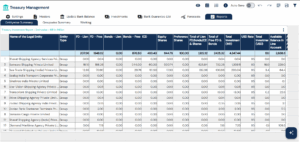
Strengths of AI-Driven Treasury Management Solutions
AI-based treasury systems would leverage machine learning algorithms, predictive analytics and data classification models to enable treasury activities. The systems would be trained on historical data to determine payment cycles, seasonality and behaviour-based risk trends. Projections would be filtered based on user specific demand trends for better mapping of future cash flows.
The company’s transaction information from bank feeds, third-party platforms and ERP systems will be automatically categorized. Payment files would be monitored for outliers while delays in approvals, payment bottlenecks or cash deficiencies would be indicated through alerts and notifications. Treasury teams would be able to prioritize outflows, minimize idle balances and fill funding gaps with the help of predictive insights.
Document processing models will process data from contracts, invoices and bank statements. All these functions would lower manual effort and enhance document accuracy. Treasury teams will be concentrated on review and exception handling.
Advantages for Corporate Finance Teams
Cash Forecasting:
AI models would run over historical cash flows, vendor behaviour and receivable cycles. Forecasts would get automatically updated as and when transactions are posted while differences from forecast values would be highlighted for inspection.
Liquidity Management:
The past and future inflows and outflows would determine the requirements of working capital. The liquidity risks from outstanding receivables, overdue payments to suppliers or unforeseen outflows would be detected by treasury management solutions powered by AI models.
Payment Optimization:
The treasury teams would prioritize their payment runs according to due dates, early payment discounts or availability of funds. They will check system recommended suggestions prior to approvals.
Fraud Detection:
Treasury management solutions will alert the treasury teams if any uncommon payment behaviour, bank details or duplicate invoices are found using anomaly detection model. They will also track user access reports and transaction histories.
Reconciliation Efficiency:
Banking transactions would be automatically matched against ERP accounts. Mismatches would be grouped and exception rules would be enforced. Large-volume reconciliation routines would be performed in time.
Effect on Strategic Decision-Making
Treasury dashboards would be offered with leading indicators by AI tools while scenario planning models would forecast funding positions under different scenarios. Treasury managers would examine results of interest rate changes, currency fluctuations or delayed receivables.
Funding needs would be matched against projected working capital deficits. Treasury management solutions would prioritize investment opportunities on the basis of yield, maturity and liquidity needs. On the basis of data analysis, treasury policies would be modified. Board reports would feature graphic summaries, critical risk indicators and compliance measures.
Treasury groups would be able to develop contingency plans for various risk scenarios as ai- based models would provide stress testing, sensitivity analysis and financial simulations where the historical event’s data of the company would be employed fir simulating future scenarios.
Data Integration and Process Alignment
Treasury management solutions powered by AI will interface with ERP modules, payment gateways and compliance platforms. The data pipelines would align with daily transactions, approvals and reconciliations while system logs and time- tracking reports would identify process bottlenecks.
The system roles would be in line with internal controls while segregation of duties would be ensured. Treasury managers would regulate user activity, workflow delays and data anomalies while audit trails would ensure compliance with financial regulations.
The internal teams would collaborate using shared data views, structured dashboards and periodic reports then decision making would be transformed from reactive updates to data -driven planning. The system configurations would mirror with company policies, market conditions and compliance requirements.
Conclusion
AI-powered Treasury management solutions would redefine corporate finance where manual processes would be substituted by intelligent automation and financial planning, risk monitoring and liquidity management would become proactive disciplines. Data models, predictive reports and system warnings will inform day-to-day business and strategic decisions. Treasury teams would function with enhanced control, governed insight and planning precision. AI powered treasury systems would bring a significant change towards future -proofed corporate finance functions.
