
The role of a CFO in today’s fast paced financial world has evolved far beyond traditional accounting and budgeting. A Modern CFO would be expected to act as strategic leaders, who would oversee liquidity, manage risk and ensure that every financial decision would align with long-term business goals. But with growing regulatory demands, multiple banking relationships and complex cash operations, manual treasury processes would be no longer sufficient.
This is where a Treasury Management System will step in. The system is not just a tool but an essential digital ally that would help CFOs gain visibility, control and confidence in every aspect of treasury operations. In this blog, we will explore what a Treasury Management System is, why it’s indispensable for modern CFOs and the top features every finance leader should know.
What Is a Treasury Management System?
A Treasury Management System is an integrated software solution designed to automate, streamline and centralize an organization’s treasury functions. These would include managing cash flow, liquidity, payments, banking relationships, risk exposure and financial reporting.
The core objective of a treasury management system will be to provide real-time visibility into an organization’s financial health. By connecting with ERP systems, banks and financial data sources, it would enable CFOs and treasury teams to make informed, data-driven decisions quickly and accurately.
In simple terms, a treasury management system would help enterprises optimize working capital, reduce risk and ensure compliance all while minimizing manual effort and human error.
Why Treasury Management Systems Are Essential for CFOs?
The responsibilities of CFOs have expanded dramatically. They are now accountable not only for financial performance but also for strategic forecasting, compliance and operational efficiency. Spreadsheets and manual reconciliations may have worked in the past, but in today’s globalized financial environment, they will pose major limitations.
A Treasury Management System will equip CFOs to:
- Gain real- time visibility into company- wide cash and liquidity positions.
- Improve risk control and ensure compliance with changing regulations
- Enhance forecasting accuracy through automation and data analytics
- Streamline payment processes across multiple geographies and currencies.
To summarize, treasury for the entire organization would be transformed from a reactive support function into a proactive strategic partner with the help of modern treasury management system.
Top Features of a Treasury Management System

Every CFO looking to implement or upgrade a treasury management system should understand its key features and how they deliver value. Below are the top capabilities that would define an effective Treasury Management System.
1. Real-Time Cash and Liquidity Management
Visibility is everything in treasury operations. A treasury management system would consolidate cash balances across multiple accounts, subsidiaries and regions thus providing a single, real-time view of liquidity.
This would help CFOs:
Optimize idle cash across global accounts
Forecast cash positions more accurately
Make data- driven investment and borrowing decisions
The organization would always know where its money is and how best to deploy it as the treasury management would be able to provide real- time updates.
2. Automated Payment Processing and Reconciliation
The key pain point for treasury teams would be managing payments and reconciliations manually. A robust treasury management system would automate these processes thus making more accurate payment execution and enabling faster across domestic and international channels.
The system would connect directly with banks thus eliminating duplicate data entry and reducing the risk of human error. Automated reconciliation would also ensure that all payments, receipts and journal entries would match up seamlessly thus saving hours of manual effort.
3. Risk Management and Hedging Tools
In volatile financial markets, managing risk exposure will be crucial. A treasury management system would help identify risks related to foreign exchange, interest rates and credit and would provide analytics to support hedging strategies.
The advanced systems would include scenario modelling and stress-testing tools that will allow CFOs to assess how different market conditions could impact cash flow and profitability thus helping them prepare for uncertainty with confidence.
4. Cash Forecasting and Planning
Accurate cash forecasting is the foundation of sound financial management. With a treasury management system, CFOs would be able to use historical data, trend analysis and predictive algorithms to forecast future cash flows.
This would improve working capital planning and ensure that liquidity is available when and where it’s needed most. The result would be better investment decisions, reduced borrowing costs and greater financial agility.
5. Bank Account Management
The large enterprises would often manage dozens or even hundreds of bank accounts across countries. A treasury management system would simplify this complexity by providing centralized control over all banking relationships.
The treasury teams would be able to monitor balances, fees and signatories from one platform thus making it easier to manage bank connectivity, track transactions and standardize reporting. This not only would improve efficiency but also reduce banking costs and operational risk.
6. Compliance and Security Management
The regulatory compliance and data security are top priorities for every CFO. A treasury management system would include built-in controls to ensure adherence to frameworks such as SOX, IFRS and GDPR and would maintain detailed audit trails for transparency.
Multi-level user authentication, role-based access and data encryption would protect sensitive financial information from unauthorized access. Automated approval workflows and fraud detection will further alert and strengthen security and governance.
7. Reporting and Analytics Dashboard
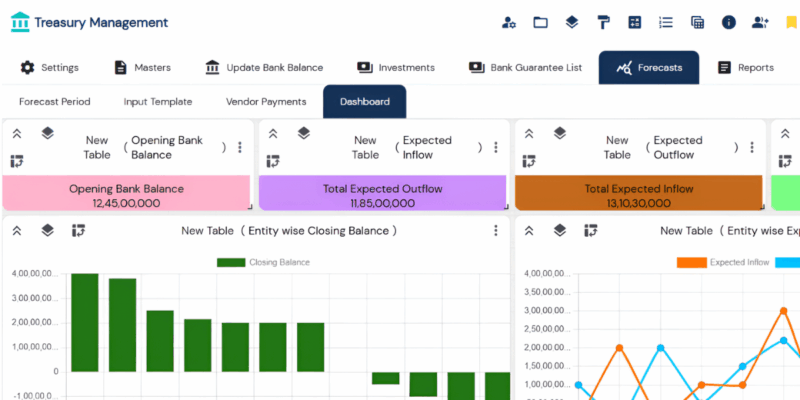
One of the most valuable features of a treasury management system is its customizable reporting and analytics dashboard. The CFOs can access real-time performance metrics, liquidity ratios and compliance KPIs at a glance.
These insights would enable proactive decision-making, better forecasting and strategic scenario planning. Whether preparing for a board meeting or an external audit, treasury management system generated reports would simplify complex data into actionable intelligence.
8. Integration with ERP and Banking Systems
A Treasury Management System is most effective when it would connect seamlessly with your organization’s ERP, accounting and banking platforms. The integration would eliminate data silos thus ensuring accuracy and consistency across all financial systems.
This connectivity would enable end-to-end automation from transaction initiation to reconciliation while improving both accuracy and operational speed.
How These Features Empower CFOs?
The way CFOs lead can be transformed with the combined impact of these features which would go beyond operational efficiency. By automating treasury functions and centralizing financial data, CFOs would gain:
- Greater control over global cash and liquidity
- Real- time visibility for faster decision making
- Reduced risk through automated compliance and fraud monitoring
- Strategic agility to respond quickly to market changes.
Thus, a treasury management system would enable CFOs to shift focus from transactional oversight to strategic financial leadership.
Key Considerations When Choosing a Treasury Management System
Before selecting a treasury management system, the CFOs should evaluate:
- Scalability– Can it grow with your organization’s global needs?
- Ease of integration – Does it work seamlessly with your existing ERP and banking systems?
- Vendor credibility– What’s the vendor’s experience, support model and client base?
- Cloud vs On- premise – Which deployment model would align with your data security and IT strategy?
- ROI Potential – Will the long- term value outweigh implementation costs?
For organizations, conducting a thorough needs analysis and comparison would ensure the right fit for your treasury goals.
Conclusion
For CFOs seeking efficiency, control and foresight in today’s financial landscape treasury management system is not just a luxury but a necessity. The system would empower CFOs lead with confidence and clarity with capabilities spanning real -time liquidity tracking, automated payments, risk management and advanced analytics. In an era where data- driven decision making would define success, investing in treasury management system is one of the strategic moves a finance leader can make.
