

Corporate Treasury departments have an important role to manage cash, liquidity, financial risks and payments across complex organizational structures. The tools thus used for these functions would determine the accuracy, consistency and control of financial operations. The tools used in traditional banking would offer standard services such as account access, payments and basic transaction records whereas treasury management solutions would provide structured system with integrated capabilities across treasury functions. This blog explores a comparison between the two approaches that would help organizations evaluate long-term suitability.
Overview of Traditional Banking Tools
Traditional banking tools would include bank portals, account statements and basic reporting features and these tools would provide access to balances, transaction history and payment processing on a per–account basis. Treasury departments would often rely on spreadsheets to consolidate financial data. Many processes like payment approvals, reconciliation and cash forecasts would be handled manually and interactions with banks would involve document submissions, email threads and static forms as data would reside across files, folders and systems without central visibility.
These limitations would affect the company’s data quality, process transparency and reporting timelines as they would expand operations, traditional tools would struggle to scale across multiple currencies, subsidiaries and accounts. Dependency on manual processing would increase the likelihood of reconciliation errors and payment delays.
Introduction to Treasury Management Solutions
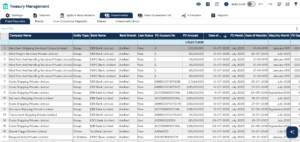
Treasury management solutions will function as a centralized platform that would integrate treasury processes across entities and departments. The system would connect with bank feeds, ERP systems and internal databases. Real -time cash positions, payment workflows, liquidity forecasts and compliance reports would be presented in structured formats while system modules will follow a defined configuration based in corporate policies
Processes such as bank account management, investment tracking, risk exposure analysis and intercompany settlements would be managed in a single environment. Treasury teams work with standardized reports, dashboards and alerts, treasury management solutions would align the system with internal controls and regulatory requirements.
Comparison by Key Functional Areas
| Key Functional Areas | Traditional Banking Tools | Treasury Management Solutions |
|---|---|---|
| Cash Visibility | Separate logins and manual consolidation in spreadsheets | Consolidated visibility across all banks, accounts and regions; categorized by currency, account type or entity |
| Liquidity Planning | No forecasting tools; dependent on spreadsheets with inconsistent data | Forecasting tools based on past transactions, payables and receivables; consistent data models |
| Payments and Approvals | Manual uploads, individual entries, external approval trails | Bulk payments, multi-tier approvals, user access controls and validation workflows |
| Reconciliation | Manual matching using downloaded bank statements | Automated matching with ERP records using defined rules; exceptions flagged |
| Compliance and Audit | Limited documentation; which would require separate records | Policy controls, user logs, approval histories; exportable reports for audit and compliance |
| Reporting and Decision Support | Bank statements and static reports; custom reports which would require manual compilation. | Templates for dashboards, board reports and disclosures; structured outputs for decision-making |
| Scalability and Control | Manual processes, file dependencies, isolated data views | Scales across geographies, users, and rules; access control would ensure segregation of duties |
| Integration with Enterprise Systems | No integration; data movement through downloads, uploads or manual entry | Connects with ERPs, accounting systems, and banks; would automate transaction flow and reconciliation |
Use Case Scenarios: Treasury Management Solutions vs Traditional Banking Tools
Manufacturing Industry
Manufacturers will operate across plants and suppliers. Traditional tools will fragment cash visibility thus requiring manual consolidation. Treasury systems would centralize account balances by plant and currency. If the treasury teams would use traditional tools, procurement cycles would be omitted often as liquidity planning would be done using spreadsheets but with treasury management solutions this would not be the case as it would forecast needs based on production and payment schedules. Reconciliation for import and vendor payments would be slow with manual matching. Treasury systems would automate this using ERP integration thus reducing delays and mismatches.
Retail Industry
Retailers would manage transactions across stores and channels where traditional tools would require manual cash tracking for each location. While treasury management solutions would provide centralized dashboards showing real- time balances. Vendor and landlord payments will be processed manually using traditional tools which would risk errors while treasury systems would automate bulk payments with approval controls. Planning with the help of traditional tools will be limited as it would be done through static files whereas treasury dashboards would support funding decisions for peak season.
Service Industry
Service firms would rely on client-based revenue. Traditional tools would track receivables through spreadsheets thus delaying updates whereas treasury systems would integrate with project tools while enabling real-time visibility. Active contract timelines would be missed by using liquidity planning with past averages while treasury systems would forecast based on project milestones. Traditional compliance would lack audit trails while treasury managements solutions would have the log for approvals and transactions for accurate audits.
Which One is Better?
Treasury management solutions would provide broader capabilities across key areas such as cash visibility, liquidity planning, payment workflows, reconciliation, compliance, reporting, scalability and integration. On the other hand, traditional banking tools would support basic banking operations but they would lack the structural depth required for centralized treasury control. Treasury systems would consolidate financial data, automate repetitive tasks and align with enterprise systems thus making them more suitable for organizations with complex treasury needs. Therefore, for businesses looking for advanced control, scalability and financial accuracy, treasury management solutions would offer a more comprehensive and efficient framework than traditional banking tools.
Conclusion
Corporate treasury teams would have a centralized, structured and policy-aligned framework for treasury operations with the help of treasury management solutions. Traditional banking tools would provide basic account access but there would be limited transaction handling. Organizations should prioritize treasury management solutions with increasing operational scale, financial complexity and compliance demands as it would be a suitable option than traditional tools in such cases. Treasury management solutions would enable financial visibility, process control and strategic readiness in modern enterprise environments.
