
Introduction
For a company’s financial stability, long term planning and risk preparedness effective treasury management would be crucial. As organization would grow, their financial operations would become more complex which would involve cash forecasting, liquidity tracking, investment planning, foreign exchange risk, compliance requirements and payment governance. The manual methods and fragmented systems would often fail to keep pace with the increasing demands of modern finance. This gap is where treasury management solution would play a crucial role.
In today’s times, treasury teams are expected to move beyond routine cash tracking and deliver strategic insights that would support business growth. They have to manage real-time data, ensure accurate cash visibility, optimize working capital and mitigate risks across multiple accounts, currencies and regulatory environments. The treasury management solutions would help organizations modernize their treasury operations, automate routine tasks and strengthen financial decision-making. However, implementing these solutions would not be enough, businesses will need to continuously review and transform their treasury management capabilities to meet evolving financial and technological demands.
In this blog, we look into what treasury management solution are? why business should use them and the steps to take to transform treasury management solutions for greater efficiency, accuracy and resilience.
What Is Treasury Management Solutions?
Treasury management solutions refer to the technology, processes and tools companies would use to manage their cash, liquidity, financial assets, liabilities and financial risks. These solutions would streamline treasury functions and centralize financial data to help organizations make more informed decisions.
A treasury management solution would typically include features such as:
- Cash and liquidity management: It would provide real-time visibility into cash positions across multiple bank accounts, currencies and regions.
- Cash flow forecasting: The solution would help predict cash inflows and outflows based on historical data and business activity.
- Risk management: It would support monitoring and mitigation of currency risk, interest rate risk, credit exposure and market volatility.
- Bank account management: The solution would centralize account information, signatories, access permissions, and controls.
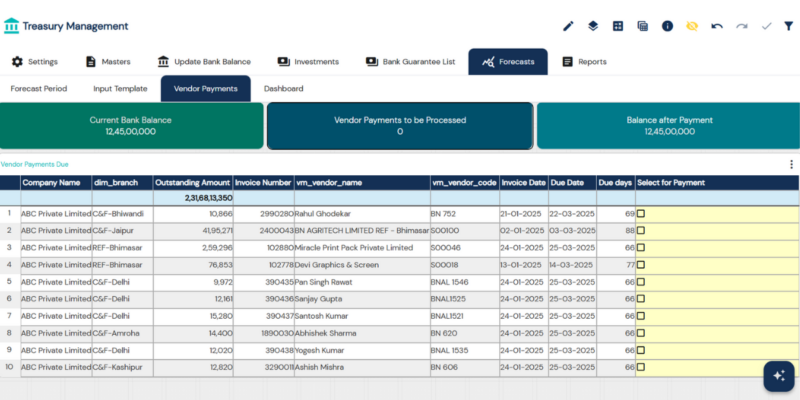
- Payment automation: The treasury management solution would standardize and automate payment workflows with strong approval controls.
- Investment management: The solution would track long- and short-term investments, yields and compliance requirements.
- Compliance and reporting: For compliance and reporting, the treasury management solution would automate regulatory reporting and audit trails to improve transparency and governance.
The companies would be able to move from manual spreadsheet- based processes to integrated, automated systems with the help of treasury management solution that would support real-time financial decision-making.
Why Should Businesses Use Treasury Management Solutions?
Treasury management solutions would provide organizations with several measurable benefits that will directly impact financial efficiency and strategic decision-making. The primary reasons businesses should adopt these solutions will include:
1. Improved Cash Visibility and Control
Businesses would often operate multiple bank accounts across regions. Without centralized visibility, treasury teams would struggle to understand true cash availability. Treasury management solutions would consolidate all balances and transactions in one platform thus enabling real-time oversight and preventing idle cash.
2. Stronger Working Capital Optimization
Treasury teams would be able to improve their cash conversion cycles with the help of the accurate data on receivables, payables and inventory. The solutions would support proactive working capital decisions such as optimizing payment timings or planning short-term investments.
3. Reduction in Manual Effort and Errors
The manual spreadsheet- based treasury processes are time-consuming and prone to human errors whereas automated workflows would streamline repetitive processes such as reconciliations, payment approvals, reporting and forecasting.
4. Better Risk Management
Treasury management solutions will help identify risk exposures early and measure the impact of currency fluctuations, market changes or interest rate movements. This would enable forward-looking risk mitigation.
5. Regulatory Compliance and Audit Readiness
For organizations, it would be easier to comply with regulations and to maintain audit trails with centralized documentation, automated logs and standardized reporting.
6. Enhanced Decision-Making
Treasury teams would be able to access consistent, real-time financial data to support budgeting, forecasting and fund allocation. The leadership would be able to make informed and timely decisions based on such data.
Steps to Transform Treasury Management Solutions

To transform treasury management solution will be essential for organizations who are aiming to modernize their financial operations. A transformation strategy which is strong would help companies move from fragmented systems to a fully integrated, data driven treasury function. Following are the key steps to guide this transformation:
Step 1: Assess Existing Treasury Processes and Technology
The transformation of treasury management solution would begin with a detailed assessment of current treasury workflows, technology limitations, data challenges and control gaps. This would include:
- Reviewing cash management processes
- Identifying manual or redundant activities
- Assessing the quality of treasury data
- Evaluating current system capabilities
- Highlighting bottlenecks and inefficiencies
A clear understanding of the existing environment would enable organizations to identify high-impact improvement areas.
Step 2: Define Treasury Goals and Transformation Priorities
Organizations should set clear objectives for their treasury transformation. These goals may include:
- Improving cash visibility
- Automating payment processes
- Strengthening risk management
- Enhancing forecasting accuracy
- Enabling real-time reporting
The treasury management solutions will be tailored to organizational needs rather than implemented as generic systems when their goals are aligned with broader business priorities
Step 3: Select the Right Treasury Management Solution
Choosing the appropriate treasury management solution is one of the most critical steps. Businesses should evaluate solutions based on:
- Scalability
- Integration capabilities with ERP, banks and financial systems
- Security features
- Real-time data processing
- Automation options
- User experience
- Customization flexibility
For an organization’s long-term success, partnering with a vendor that would offer technical support, regular enhancements and compliance updates would be essential
Step 4: Ensure Seamless Integration with Existing Systems
A treasury management solution will provide maximum value only when integrated properly with ERP systems, bank APIs, accounting tools and payment gateways. Strong integration would ensure:
- Real-time data flow
- Accurate reconciliations
- Automated transaction updates
- Consistency across financial records
This would reduce manual intervention and minimize inconsistencies across financial systems.
Step 5: Automate Critical Treasury Functions
Automation would simplify treasury tasks and reduce operational risk. Companies should begin by automating high-impact processes such as:
- Cash position reporting
- Forecasting
- Bank reconciliations
- Payment approvals
- Risk exposure tracking
- Compliance reporting
Automation would not only speed up processes but also improve accuracy and transparency.
Step 6: Strengthen Treasury Governance and Controls
The effective governance would ensure secure, compliant and accountable treasury operations. Transformation initiatives should include enhancements to:
- Access controls
- Segregation of duties
- Approval workflows
- Audit trails
- Fraud prevention systems
Stronger governance would reduce risk and enhance trust in treasury data.
Step 7: Monitor Performance and Continuous Improvement
Transforming treasury is not a one-time activity. Organizations should continuously monitor system performance, user experience, reporting effectiveness and integration health. The regular evaluations will help identify improvement areas and ensure treasury management solutions remain aligned with evolving business needs.
Conclusion
The businesses would be able to streamline financial operations, improve cash visibility, enhance risk management and support strategic planning with the help of treasury management solutions. The organizations should shift from manual treasury processes to automated, data-driven and integrated systems as the financial environments would become more complex.
A structured approach will be required to transform treasury management solutions, the approach will include assessing current processes, defining clear objectives, selecting the right technology and ensuring strong governance. Such continuous monitoring and process improvements would further enhance treasury performance.
By following such transformation steps, businesses would be able to build a modern treasury function that would support growth, resilience, financial stability and long-term success of the organization.
