
Bank reconciliation is a process where a business would compare its internal financial records with its bank statement. The purpose of this process would be to identify the differences between these two records. These differences may include outstanding cheques, deposits in transit, errors or bank fees. Bank reconciliation process would help in accuracy of financial records. The process would ensure that the cash records of the business would match with the bank’s data.
What is Bank Reconciliation?
The process would include checking each transaction, matching bank entries with ledger entries, identifying unrecorded transactions and recording adjustments for accuracy. The end result of this process would be a reconciled statement.
Challenges of Manual Reconciliation
Manual bank reconciliation process would present many challenges to the business. These could be large transactions leading to time- consuming tasks, human errors during data entry and matching would cause discrepancies and delays in identifying such issues would create risk for the company. Staff dependency would result in slow processes. Manual checking would lack real- time updates as spreadsheets and paper- based formats would complicate tracking. Manual bank reconciliation would lead to difficulties in handling multi- bank or multi- currency operation may arise. Audit trail maintenance would become a burden making the bank reconciliation process stretch due to limitations.
Bank reconciliation process would be delayed due to missing documents or mismatched entries. Investigation of such issues would become difficult as accuracy would decrease due to fatigue and financial closings would be delayed. Such issues would cause cash flow to suffer, increase the risk of fraud due to limited oversight and would make regular compliance complex.
How Can Bank Reconciliation Software Be Automated?
Bank reconciliation process could be automated through bank reconciliation software solutions. These solutions would integrate accounting systems and banking platforms. Automation would remove manual tasks and systems would be able to import bank data and ledger data automatically. Transaction matching would occur through predefined rules while it would be easy to highlight discrepancies. Reconciliation would be completed through system intelligences as adjustment entries would be suggested automatically.
Automation would include use of APIs for bank feeds. Scheduled import would run daily or weekly. Machine learning would help in pattern identification while rule -based engines would detect duplicates, errors and missing items. Reconciliation would occur continuously as reports and dashboards present the status. Integration with enterprise resource planning (ERP) systems would streamline processes.
Steps to be Followed for Automation
Step one will include assessment of current bank reconciliation process. This would include mapping existing workflows, identification of pain points and determination of volume, frequency and complexity.
Step two will include selection of bank reconciliation software. This would include evaluation of features such as bank integration, ledger compatibility, multi-currency handling, audit support and reporting.
Step three will include configuration of the system. The configuration would include setup of chart of accounts, setup of rules for transaction matching, creation of templates for statement imports and integration with accounting platforms.
Step four would include data migration which includes import of historical bank data, Import of general ledger transactions and accuracy testing.
Step five would include training of staff. This may include introduction of system navigation and explanation of workflows and exceptions.
Step six will make system go-live. Daily processing would begin which would make reconciliation run based on defined frequency. This would make exceptions get flagged and users would review and approve system-suggested entries.
Step seven would be monitoring and improvement. In this step automation performance can be reviewed, rules could be adjusted, workflows can be optimized and system reports would be used for compliance and audit.
Benefits of Automating Bank Reconciliation Software
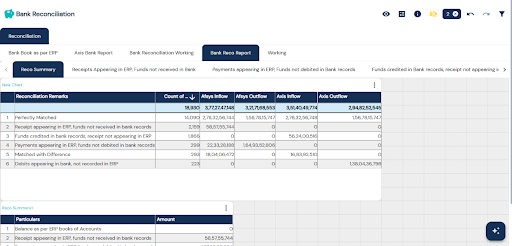
Automation would improve processing time while matching transaction complete faster. Bank reconciliation cycle would shorten making staff resources get optimized. Accuracy would increase; human errors would decrease; duplicate entries would get flagged and detecting fraud would become easier.
Real-time insights would improve decision-making of the finance teams. The cash balances would stay updated and integration with ERP would enhance visibility. Automation would support multiple banks while scalability would improve with growth. Compliance requirements will get fulfilled as documentation and audit trails stay intact. Monthly and quarterly closings would become easier. Exception management would become more efficient.
Automation would provide centralized control as cloud access would allow remote operations. Collaboration across teams will increase. The custom reports would support analytics. Multi-level approvals may improve governance while historical records stay accessible to the finance teams. The security of such reports would improve through controlled access.
Conclusion
Bank reconciliation process will remain a critical financial function for businesses. Manual processes would create risks and inefficiencies whereas automation would simplify reconciliation. Moreover, bank reconciliation software would improve speed and accuracy. Rule- based matching, real-time data and seamless integration would enhance the process. Steps such as system selection, configuration and user training would ensure smooth transition. Automated reconciliation would offer benefits across efficiency and control. Businesses would achieve better financial management through automation.
