
What is Expense Management?
Expense management refers to the process of tracking, processing and controlling business expenses. It would include employee reimbursements, vendor payments, travel costs, procurement expenses and other operational outflows. Manual expense management will involve paperwork, spreadsheets, receipts and multiple approval levels thus often leading to inefficiencies and delays.
The shift from manual to automated expense management has become a structural requirement for organizations of all sizes. By adopting automation, businesses would gain visibility into spending and ensure alignment with budgets and corporate governance policies. In this blog we will understand what is expense management automation and its benefits which would make companies seek better financial control, accuracy and efficiency.
What is expense management automation?
Expense management automation is the application of digital tools and systems to automate the entire expense lifecycle. It would involve the use of platforms that record, categorize, validate and reconcile expenses in real time. These systems would provide companies with centralized control, compliance with policies and integration with accounting software.
Expense management automation is a technology-based framework which would gather expenses from disparate sources, it enforces policy rules and ensures direct financial system integration. The system would eliminate manual entries, replicated data and disrupted approval chains. It would provide expense reporting uniformity among departments and ensure the expenses are posted in accordance with tax and regulatory requirements.
Expense management automation solutions will typically include:
- Digital capture and receipt scanning
- Policy-based approval processes
- Tie-in with corporate credit cards and ERP systems
- Real-time monitoring of employee expenses
- Management dashboards for analytics to give control
- Automatic bank account reconciliation
- Roles-based access for financial staff and auditors
This would enable companies to budget and control expenses more efficiently.
Advantages to Companies
Expense management automation would be a structural advantage to companies across all sectors.
- Timeliness – The computerized systems would ensure duplication of expenses is not done and would categorize the expenses accurately into cost accounts.
- Time Efficiency – Electronic approvals and automated report generation would minimize processing time and remove reimbursement delays.
- Regulatory Compliance – Automated systems will validate expenses as per internal policy and external tax regulations.
- Data Transparency – Companies would gain real-time access to expense reports and cross-departmental visibility.
- Cost Control – Monitoring and analysing expense patterns will enable companies to prevent wastage and optimize the utilization of resources.
- Increased capacity – The systems can handle higher volumes of transactions without additional manpower requirements.
- Prevention of Fraud – The risk of unauthorized or duplicate claims would be reduced by built-in policy checks and audit trails.
- Central Storage of Records – Secure access for audits and reviews will be possible as the records would be stored electronically.
- Budget Alignment – The managers would be alerted about variations in budgets and the system would link expense categories to approved budgets.
- Multi-Currency Support – The businesses operating across borders would welcome exchange rate integration and uniform expense reporting across countries.
Use Case Scenarios: Industry-Specific
The applications of expense management automation would differ from one industry to another. These examples serve to describe its applications in the following industries:
Retail Industry
- Supplier invoice recording by different vendors.
- Automation of promotional expense tracking in retail outlets.
- Integration of e-commerce platform expenses with accounting systems.
- Tracking of travel and logistics expenses of field staff.
- Centralized monitoring of utility payments in the branches.
- Keeping seasonal cost peaks under control during festivals or sales campaigns.
- Compilation of expenses from offline and online platforms for accurate reporting.
Manufacturing Industry
- Tracking of raw material purchase costs across plants.
- Automating expense claims of on-site engineers and technicians.
- Resynchronization of vendor payables with supply chain management systems.
- Tracking of operational and energy costs in factory plants.
- Combination of multi-currency import-export transactional costs.
- Identification of research and development costs with specific projects.
- Distribution of plant-level overheads for effective cost accounting.
Service Industry
- Capturing of travel and hotel costs on client project work.
- Automation of training and certification costs of professionals.
- Including subscription-based software costs in accounting records.
- Tracking payments to contractors by geography.
- Distribution of costs to specific client projects for billing.
- Aggregating advertisement and marketing expenses for campaign-related purposes.
- Customer reimbursement policy automation of consulting and advisory services.
These examples would show how automation combines costs with industry-specific processes and cost structures.
Future of companies using expense management automation
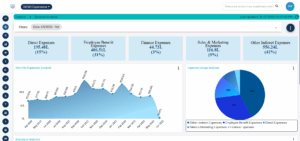
Firms using expense management automation in the future would imply several structural changes:
- Data-Driven Decisions – Predictive analysis and budgeting would be possible for companies due to visibility of expenses in real-time.
- Integration with Artificial Intelligence and Machine Learning – Better analytics would be possible as the automated systems would categorize and forecast spending of the companies
- Paperless Operations –The dependence on paper forms will be reduced due to scanning receipts and electronic workflows.
- Global Compliance Alignment – The systems will be able to adapt to evolving tax and regulatory environments in geographies.
- Employee Experience Improvement – The improved reimbursement would make the reporting process faster which would enhance workforce engagement
- Sustainability Alignment –The companies will monitor energy, travel and supply chain cost for sustainability reporting.
- Cloud-Based Expansion – The cloud-based expense systems will allow scalability for multi-country operations.
- Integration with Enterprise Systems – The expense management automation platform would integrate to sync with HR, payroll, procurement and treasury management solutions.
- Advanced Fraud Detection – The AI- powered monitoring would flag anomalies in real time for internal review.
- Competitive Advantage – Cost automation businesses will improve cost control and enhance resilience in volatile markets.
The expense management automation would set themselves up for growth and agility. They develop stronger governance, enhanced cost effectiveness and improved financial clarity.
Conclusion
Automating expenses would be a shift from paper to organized digital systems. The process would provide precision in finances, compliance, transparency and control. With use in retail, manufacturing and service sectors, the use of automation would ensure synchrony between business strategy and expenses.
The future of expense management automation for companies would involve integration with emerging technologies, adherence to evolving rules and regulations and the implementation of sustainable costs practices. The companies investing in such systems would be building sounder foundations for financial stability and long-term security.
