
Bank reconciliation is a systematic process that would compare internal company records with external bank statements. It will capture inconsistencies; highlight mistakes and guarantee balances reconcile across systems. Without a formal process, the firms will likely have inconsistent reporting, late detection of inconsistencies and poor compliance records. A bank reconciliation solution will correct these issues by simplifying the process, aggregating financial data and guaranteeing consistency between accounts.
This article explains what a bank reconciliation solution is, how it improves financial accuracy, its benefits to businesses and usage in different industries.
What is a Bank Reconciliation Solution?
A bank reconciliation solution is an internet-based solution that would automate reconciling company-ledger postings with bank-reported data. It is designed to maintain balances accurate, reporting clear and tracking transactions efficient.
Core Features of Bank Reconciliation Solutions
- Automated Data Import: The solution would bring in data from accounting systems and bank feeds.
- Transaction Matching Engine: It would reconcile company entries and bank transactions.
- Exception Handling: It would spin out unmatched flags or double posting of transactions.
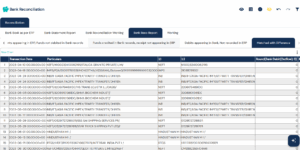
- Consolidated Dashboards: Bank reconciliation solution provides a consolidated view of cash positions.
- Storage of Historical Record: It would keep reconciliation history for audit trails.
- Multi-Currency Support: The solution will have reconciliation with global transactions.
By integrating with enterprise resource planning (ERP) systems, a bank reconciliation solution will ensure consistency across all financial functions.
How Can a Bank Reconciliation Solution Improve Your Financial Accuracy?
Accuracy in financial reporting would depend on alignment between internal accounts and bank data. A reconciliation solution will improve this alignment through structured processes and system-driven checks.
1. Eliminating Manual Errors
Manual reconciliation would depend on spreadsheets and repetitive entries which would create gaps. A reconciliation solution would eliminate inconsistencies by automating transaction matching.
2. Transparent Financial Visibility
The real-time synchronization between accounts and banks would create transparency in cash flow. Financial staff would be equipped with reconciled dashboards that reflect true balances.
3. Faster Error Recognition
Any imbalances such as slow deposits, unauthorized draws or lost receipts will be flagged early. This would assist companies to react before the imbalances affect reporting cycles.
4. Process Standardization
Reconciliation processes will vary for varying teams. A solution for bank reconciliation would provide standardized workflows thereby providing financial accuracy between departments consistently.
5. Enhanced Compliance
With reconciled reports and saved reconciliation histories, companies can demonstrate compliance while submitting tax filing or external audits. This will reduce threats of penalties and regulatory interventions.
Benefits of Bank Reconciliation Solution for Companies
1. Improved Financial Record Reliability
- There will be consistent matching of bank statements and internal ledgers.
- There would be elimination of duplicate, missing or incorrect entries.
- There will be reliable reflection of company liquidity
2. Efficient Use of Resources
- Automated processes would replace manual data entry.
- The financial teams would be able to focus on analysis instead of repetitive tasks.
- There would be reduced dependency on spreadsheets.
3. Real-Time Cash Flow Monitoring
- There would be continuous synchronization of data across accounts.
- Bank reconciliation solution would make sure there is up-to-date visibility into inflows and outflows.
- There would be better planning for operational and strategic decisions.
4. Support for Business Growth
- The increasing transaction volumes would be handled by scalable solution
- Multiple bank accounts and subsidiaries will integrate within one system.
- The bank reconciliation solution will make cross-border payments and multi-currency reconciliations remain manageable.
5. Audit Readiness
- Comprehensive audit trails would simplify reviews.
- Transparent historical data will support external verification.
- There would be simplified compliance reporting reducing regulatory risks.
Used Cases in Industries
Retail
- Reconciliation of daily deposits and sales receipts with deposits across stores and online platforms would be possible with bank reconciliation solution.
- Tracking chargebacks, discounts, refunds and promotional adjustments would be easier.
- Consolidating multiple payment gateways such as cards, wallets and UPI would be possible
Manufacturing
- There would be alignment of raw material vendor payments with outgoing transactions.
- The reconciliation of export and import payments in multiple currencies would be possible with the help of bank reconciliation solution.
- The tracking of capital expenditures such as machinery or equipment purchases would be easy with the solution
Services
- The reconciliation of client- based receivables with banking inflows would be easier with bank reconciliation solution.
- The alignment of payroll disbursements and statutory payments with statements is possible with the solution.
- It would be easier to track recurring subscription or retainer income.
Financial Services (Additional Use Case)
- With custodial bank records, reconciliation of investment transactions is easier.
- It would be easy to monitor large scale customer deposits and withdrawals.
- The management of regulatory reporting for compliance with financial authorities is easier with bank reconciliation solution.
Advantages Across Business Functions
For Finance Teams
- There would be reduction of manual workloads.
- A consistent framework for reconciliation cycles.
- Clear insights into liquidity positions would help finance teams.
For Management
- The reliable reports provided by bank reconciliation solution would support decision-making.
- There would be improved transparency across subsidiaries or business units.
- The ability to predict future cash requirements would be enhanced.
For Compliance Officers
- With the help of bank reconciliation solution, standardized reconciliation histories can be accessed.
- There would be simplified preparation for internal and external audits.
- There would be reduced exposure to financial penalties.
Conclusion
For any business, financial accuracy is a foundation to its stability, stakeholder confidence and regulatory compliance. A bank reconciliation solution would strengthen this foundation by aligning internal accounts with bank statements thus eliminating inconsistencies and creating transparency.
The solution would improve accuracy through automation, standardized workflows, fraud detection and real- time visibility. Its benefits would extend to improved financial reporting, efficient resource allocation, audit readiness and scalability for growing organizations.
Across industries as discussed above, bank reconciliation solutions would address unique requirements by ensuring accurate tracking of transactions
