Introduction
Bank reconciliation is a core finance function for organizations as it would ensure the alignment of a company’s internal financial records with its bank statements. This process will help verify whether the recorded cash transactions match the actual money movement in and out of the business account. While many organizations still handle reconciliations manually, the approach of such process is often slow, error-prone and difficult to scale as transaction volumes grow.
A bank reconciliation solution would solve all the issues created by manual reconciliation as it is a solution which would provide systematic, automated way to carry out the critical financial task. It would reduce manual effort, eliminate data discrepancies and support timely financial reporting. Modern reconciliation tools have evolved to deliver speed, accuracy and deep insights as digital transformation is on the rise in finance. In present day, beyond automation solutions are increasingly leveraging artificial intelligence (AI) to enhance decision-making and streamline workflows.
This blog will explain what a bank reconciliation solution is and the benefits of adopting a robust tool and further dive into how AI will add greater efficiency and intelligence to the process.
What Is a Bank Reconciliation Solution?
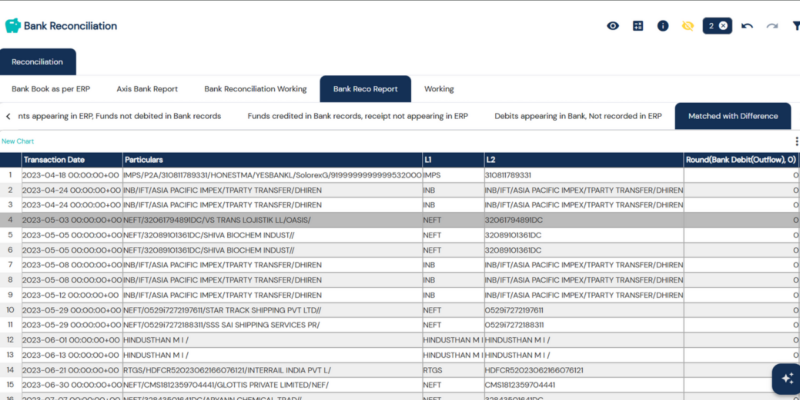
A bank reconciliation solution is a digital software platform that will automate the comparison of internal accounting data with banking statements. Instead of manually checking each transaction line by line, the solution would import data from ERP systems, bank feeds and financial applications and would automatically identify match or discrepancy.
The Key capabilities typically would include:
- Automated data import from multiple sources
- Transaction matching using predefined rules
- Exception identification and categorization
- Audit trails for compliance
- Real-time dashboards and reporting
- Secure storage of reconciliation records
The purpose of a bank reconciliation solution is to deliver accuracy, speed and visibility. The solution will standardize the process by applying consistent rules across all accounts, reducing the risk of manual errors and oversight.
Benefits of a Good Bank Reconciliation Solution

A good bank reconciliation solution would offer multiple operational, financial and strategic benefits. The following are the most significant advantages:
1. Improved Accuracy and Reduced Errors
Manual reconciliation is subject to human error such as data entry mistakes, skipped lines, outdated spreadsheets or incorrect formulas. A good bank reconciliation solution would automate the matching process thus ensuring higher accuracy and consistency. Since the solution would follow standardized rules, it would eliminate subjective judgement and enforce uniformity in how transactions would be verified.
2. Time and Cost Efficiency
The finance teams would spend hours reconciling accounts every month, especially when dealing with high transaction volumes. The bank reconciliation solution would significantly reduce the time required to match entries, freeing accountants to focus on strategic finance tasks such as forecasting, budgeting or cash flow analysis. The reduced manual work will also lower operational costs.
3. Faster Financial Close
Reconciliations would delay slow down month-end and year-end closing processes. The period-end closing would be accelerated with the help of modern bank reconciliation solution by providing real-time transaction updates and automated matching. The financial reporting would be quicker if the reconciliation is faster which would reduce bottlenecks and enable timely business decisions.
4. Enhanced Audit Readiness and Compliance
The organizations using bank reconciliation solution would be prepared more efficiently for internal and external audits with comprehensive audit trails, centralized documentation and automated reporting. A good solution would offer visibility into who performed what action, when it was completed and how discrepancies were resolved. Compliance with financial regulations and internal controls would be strengthened with this transparency.
5. Better Cash Flow Visibility
Businesses would get a clear view of available cash through accurate and timely reconciliations. The bank reconciliation solution would ensure that CFOs and treasury teams would always know their true cash position. This would improve liquidity planning, help avoid overdrafts or missed payments and support stronger financial forecasting.
6. Scalable for Business Growth
As organizations would expand, their transaction volume would grow too. Manual reconciliation would become unsustainable while a bank reconciliation solution will scale seamlessly with increasing data inputs, multiple bank accounts and high- frequency transaction. This would ensure that growth does not compromise financial accuracy or efficiency.
7. Improved Exception Management
A core benefit of a good solution would be its ability to highlight discrepancies instantly such as duplicate entries, missing amounts, unauthorized transactions or timing differences. The users can categorize and resolve these exceptions quickly leading to effective exception management which would reduce the risk of fraud or unnoticed financial irregularities.
8. Better Collaboration Across Finance Teams
The on-premises reconciliation tools would make it easier for teams across locations or departments to work together with security. The real-time access, shared dashboards and activity logs would ensure that everyone has visibility into reconciliation status. In this way, dependency on individual spreadsheets would be eliminated and communication gaps would be reduced.
What Insights Will I Get Through AI Post Bank Reconciliation?
AI does not just automate reconciliation but would also unlock deeper financial insights that manual processes would not be able to provide. Once the bank reconciliation is completed, AI- powered systems would be able to interpret the reconciled data to deliver actionable intelligence that would support strategic decision – making.
1. Clear Visibility into Cash Trends
Post bank reconciliation, AI would be able to analyse cash inflows and outflows over time to identify spending patterns, seasonal fluctuations and irregular movements. This would help finance teams understand how cash positions would evolve and anticipate future liquidity needed more accurately.
2. Identification of High-Risk Accounts and Transactions
AI would review reconciled data to highlight accounts that would frequently generate exceptions or discrepancies. It would also pinpoint transactions that would repeatedly appear as mismatches, allowing organizations to identify underlying risks such as recurring errors, operational inefficiencies or potential fraud indicators.
3. Intelligent Root-Cause Analysis
AI would provide insights into why certain exceptions occur such as whether such exceptions are due to timing differences, duplicate entries, incorrect classifications or system integration issues by learning from historical reconciliations. Such insights would help businesses take corrective action at the process level thus preventing recurring issues.
4. Vendor and Customer Behaviour Patterns
AI would be able to examine reconciled payment and receipt data to reveal patterns such as delayed customer payments, inconsistent billing cycles or early vendor settlements. These insights would support better credit control, vendor negotiation and cash flow planning.
5. Forecasting and Predictive Insights
To lay foundation which would generate predictive analytics, AI would use reconciled and accurate financial data. This would include future cash flow projections, expected payment timelines, potential overdraft risks and upcoming cash shortages or surpluses. These forward-looking insights would strengthen both treasury and financial planning.
6. Operational Performance Metrics
Reconciled data would enable AI to measure key reconciliation metrics such as:
- Average exception resolution time
- Match rates across accounts
- Frequency of manual interventions
- Error patterns linked to specific processes or systems
These metrics would help organizations understand the efficiency of their reconciliation process and identify areas for improvement.
7. Enhanced Financial Control and Governance Insights
AI would be able to highlight gaps in internal controls by comparing reconciled data against compliance rules and policies. It would also flag unusual transaction types or behaviours that may warrant review from an audit risk or risk management perspective.
Conclusion
A bank reconciliation solution would play a critical role in strengthening financial accuracy, operational efficiency and overall business control. By automating the comparison of internal records with bank statements, it would eliminate the limitations of manual reconciliations and would ensure that organizations would maintain precise, reliable financial data. The benefits of a good reconciliation solution would extend across improved accuracy, reduced errors, faster financial close, better cash flow visibility and enhanced audit readiness.
The bank reconciliation process would become even more powerful with the adoption of artificial intelligence. AI would not only increase match rates and reduce manual intervention but would also offer deeper insights into cash trends, transaction patterns, risk areas and future cash flow projections. These insights would empower finance teams to move beyond transactional work and contribute to strategic decision-making.
As organizations would scale and financial operations would grow more complex, investing in a good bank reconciliation solution powered with AI would be no longer optional. It would be a necessity for achieving real-time visibility, maintaining strong governance and ensure long-term financial stability.
