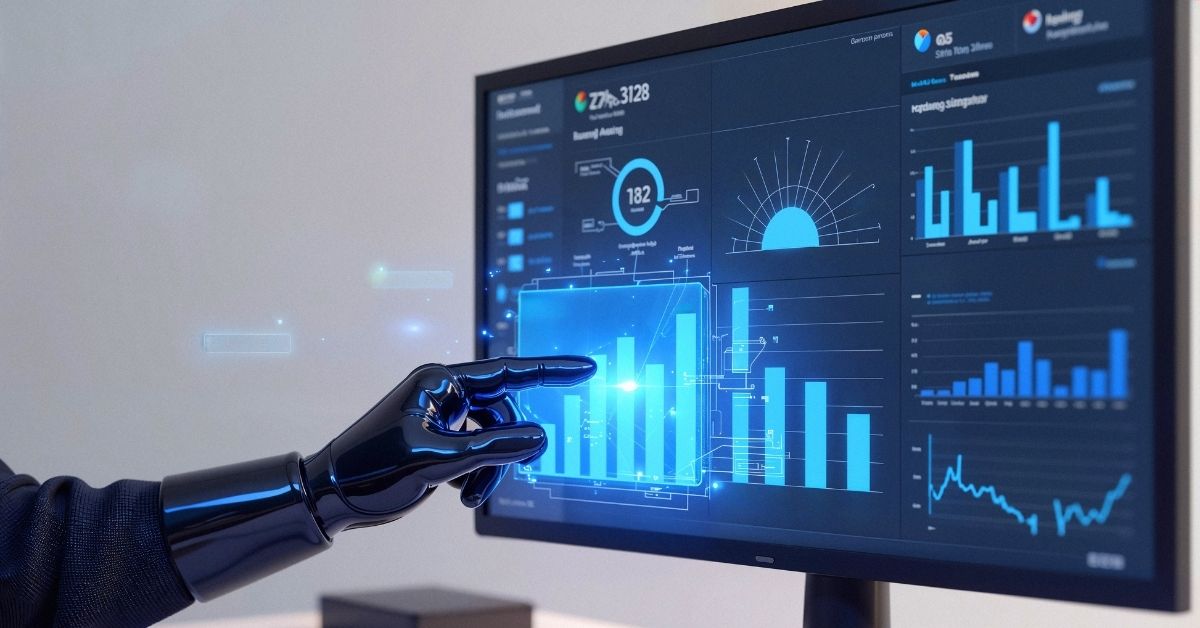
Accurate AI in financial forecasting is critical for businesses more than before as the business environment changes rapidly nowadays. Market volatility, demand fluctuation, supply disruption and economic uncertainty would make it more challenging for organizations to depend on traditional methods. The manual spreadsheets used by organizations may often miss real-time changes and complex patterns concealed in large data sets.
This is where AI (Artificial Intelligence) in financial forecasting would ultimately change how businesses plan, predict and make their decisions. By leveraging artificial Intelligence, organizations would be able to get better forecasts, faster reaction times to change and better insights into future financial performance. For industries across manufacturing, retail and services, AI in financial forecasting would become a strategic necessity.
What Is AI in Financial Forecasting and Why Should Businesses Implement It?
The use of artificial intelligence (AI) technologies including machine learning, predictive analytics and other advanced algorithms used to interpret historical and real-time financial information and predict future financial performance is known as AI in financial forecasting. AI will continuously learn from incoming data instead of being confined to fixed assumptions unlike traditional forecasting models. Thus, improving accuracy over time.
AI in financial forecasting would integrate data from multiple sources, including ERP systems, sales platforms, customer behaviour etc. These systems would bring to the surface trends, seasonality, anomalies and correlations that are often invisible to human analysts.
Why Businesses Should Implement AI in Financial Forecasting
Increased Data Complexity: Businesses today would generate massive volumes of structured and unstructured data. AI can process and analyse this data efficiently.
Need for Real-Time Insights: Traditional forecasting cycles are slow whereas AI would enable dynamic, real-time forecasting.
Competitive Advantage: Accurate forecasts would allow organizations to optimize pricing, inventory, investments and resource allocation.
Reduced Human Bias: More objective judgements would be possible as AI models would rely on data-driven insights rather than selective judgement.
Businesses would move from reactive decision-making to proactive financial planning by implementing AI in financial forecasting.
Benefits of AI for Financial Forecasting
Improved Forecast Accuracy
More accurate forecasts as compared to manual or rule-based methods would be possible as AI algorithms would analyse large datasets and detect complex patterns. This would help businesses predict revenue, expenses and cash flows with higher confidence.
Real-Time Forecasting and Scenario Analysis
Continuous forecasting would be possible as compared to periodic updates with the help of AI. Businesses would be able to model scenarios such as best case, worse case and most likely outcomes which would allow leaders to prepare for uncertainties.
Faster Decision-Making
The finance teams would no longer need weeks to prepare forecasts with AI-driven insights in real time. This speed would allow management to make timely strategic decisions.
Cost Efficiency and Automation
AI would automate repetitive forecasting tasks thus reducing the need for manual data entry and reconciliation. This would lower operational costs and would make finance professionals free to focus on strategic initiatives.
Enhanced Risk Management
AI for financial forecasting would identify anomalies, trends and early warning signals thus helping organizations mitigate financial risks before they escalate.
Real-World Use Cases of AI in Financial Forecasting
AI in finance forecasting is not limited to a single domain. Eventually, each sector will go through forecasting with its own monetary problems and opportunities.
AI in Financial Forecasting for the Manufacturing Industry
The manufacturing industry has a complex cost structure that is influenced by raw material prices, labour costs, production volumes and disruptions in the supply chain.
Use Cases:
Demand Forecasting: The manufacturers will be able to plan production in a better way with the help of AI. The program forecast would demand for a product based on historical sales, market trends and seasonal patterns.
Cost Forecasting: AI models would predict fluctuations in raw materials and energy costs, facilitating better budgeting and pricing strategies
Cash Flow Planning: Cash flow planning would involve forecasting cash flows on a factory level based on production schedules, supplier payments and customer collections.
AI-driven projections can help manufacturers lower their carrying costs, reduce surplus production and improve their bottom line.
AI in Financial Forecasting for the Retail Industry
The retail business would operate in a very dynamic environment where it is influenced by the consumer, the promotional activities, economic conditions, seasonal demand, etc.
Use Cases:
Sales and Revenue Forecasting: AI would analyse customer purchasing patterns, promotions and external factors to forecast sales at store, regional and enterprise levels.
Inventory Optimization: The retailers would be able to maintain optimal stock levels thus reducing overstocking and stockouts with the help of accurate financial forecasts.
Promotion and Pricing Impact Analysis: The financial impact of discounts, campaigns and pricing would be predicted by AI before they are launched.
The retail industry would gain better visibility into future performance thus improving both customer satisfaction and profitability with the help of AI in financial forecasting.
AI in Financial Forecasting for the Service Industry
The service industry includes services like IT services, consulting firms and financial services providers who would rely heavily on human capital and project-based revenues.
Use Cases:
Revenue Forecasting: AI would analyse customers’ purchasing patterns, sales promotion and external factors to forecast sales at store, regional and enterprise levels.
Resource Cost Forecasting: With the use of accurate financial forecasts, retailers would be able to avoid overstocking and stockouts by maintaining optimal stock levels.
Profitability Forecasting: Project profitability can be evaluated by combining cost forecasts with expected revenue streams by using AI models.
Conclusion
The conventional forecasting methods would be inadequate to meet the requirements of modern business as the financial complexity would become bigger. Through the help of Artificial Intelligence, organizations can expose themselves to better accuracy, agility and insight for smarter financial planning.
By leveraging AI in financial forecasting, industries such as manufacturing, retail and services can look forward to better prediction of future outcomes. They can better allocate resources to avoid a crisis during uncertain economic conditions. With the continued evolution of AI technology, its role in the financial forecasting is bound to become more central to strategic decision-making and giving business a sustainable success.
