
Introduction
The finance teams in present day operate in an environment where financial complexity would be constantly increasing. The organizations would have to deal with multiple bank accounts, cross-border transactions, fluctuating cash positions and growing compliance requirements. This would become overwhelming if the elements would be managed manually or through disconnected systems
This would be where treasury management solutions would play a critical role as systems would centralize financial data, automate routine processes and provide real-time insights into an organization’s financial position. This would help finance teams streamline operations, improve decision-making and strengthen their financial control.
This blog would explore the key challenges the finance teams would face and how would treasury management solutions would address these problems.
Challenges Faced by Finance Teams
1. Limited Visibility into Cash Positions
The finance teams would often struggle with a lack of real-time visibility into cash balances across multiple accounts and entities. Determining true liquidity would become difficult with cash data scattered across systems or manually tracked in spreadsheets. This limited visibility would lead to poor decision such as unnecessary borrowing or missed investment opportunities.
As a result, the treasury teams may find it challenging to forecast cash flows accurately and efficiently.
2. Inefficient Manual Processes
Many treasury departments would heavily rely on manual processes for tasks such as bank statement consolidation, transaction matching and reporting. Repetitive activities like these would consume significant time and increase in risk of human error where even small mistakes in data entry or reconciliation would lead to major financial discrepancies.
As businesses would grow, managing finances would manually become inefficient thus limiting time for strategic planning.
3. Difficulty in Managing Financial Risk
The treasury teams will have to constantly monitor risks such as currency fluctuations, interest rate changes and liquidity. Managing these risks would become highly challenging without proper tools. International operations would be especially vulnerable to foreign exchange impacts and shifting borrowing costs.
Risk management in the absence of centralized systems would become reactive rather than proactive.
4. Fragmented Banking Relationships
Organizations often work with multiple banking partners to support different regions, currencies and services which would add flexibility but increase complexity. Each bank would make consolidating financial information difficult with different data formats. The treasury teams would be able to access multiple portals to retrieve statements and transactions details.
This fragmentation would reduce efficiency and limit a unified view of the company’s financial position.
5. Lack of Accurate Cash Forecasting
Cash forecasting would be essential for maintaining liquidity and planning future investments. However, it would depend on accurate historical and real-time financial data as relying on outdated spreadsheets or incomplete data would lead to unreliable forecasts and poor decisions.
This would result in liquidity shortages or excess idle cash, hindering effective financial planning.
6. Compliance and Security Risks
Financial regulations would become increasingly stringent, requiring accurate records and compliance while manual treasury processes would often lack audit trails thus making compliance more challenging. This would also increase the risk of fraud or unauthorized transactions.
The finance teams would need secure systems with string controls and transparent reporting to meet regulatory demands.
How Treasury Management Solutions Address These Problems
1. Centralized Cash Visibility
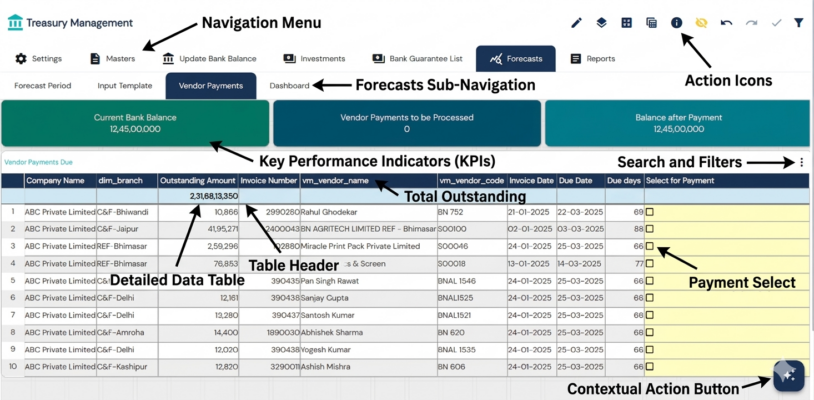
Centralized financial visibility will be a key advantage of treasury management solutions where data from multiple banks into one platform will be consolidated. The finance teams would be able to access real-time cash balances, transactions and liquidity positions across the organization. This would enable faster, more informed decision-making.
With clear visibility, the companies would be able to optimize cash use and reduce unnecessary borrowing.
2. Automation of Routine Tasks
Modern treasury management solutions would be able to automate routine tasks such as bank statement imports, reconciliation, payments and reporting. This would improve efficiency while reducing the risk of human error. The finance teams would be able to handle large transaction volumes quickly and accurately.
The automation would free treasury professionals to focus on strategic planning and risk management.
3. Enhanced Risk Management
Treasury management solutions would offer tools to monitor and manage financial risks effectively. The solution would enable teams to track currency exposure, analyse interest rate impacts and model financial scenarios. Risk would be identified early and addressed proactively with built-in analytics.
This would help organizations maintain financial stability and manage uncertainties better.
4. Seamless Bank Connectivity
The modern treasury management solutions would integrate directly with banks thus enabling access through a single interface. This would eliminate the need to log into multiple portals or manually download financial data. Bank statements, transactions and payment updates would be automatically imported.
As a result, finance teams would gain a unified view thus improving efficiency and reducing complexity.
5. Accurate Cash Forecasting
The treasury management solutions would improve cash forecasting thus using historical data, real-time transactions and predictive analytics. This would enable finance teams to create dynamic forecasts based on different scenarios and assumptions and help organizations anticipate cash needs and optimize liquidity efficiency.
Accurate forecasts would also support better investment decisions and overall financial stability.
6. Improved Compliance and Security
In treasury operations, security and compliance would be critical which would be supported by built in controls in treasury management solutions. There would be features like approval workflows, user access controls and audit trails that would ensure proper authorization and documentation. Automated reporting would help meet regulatory requirement with accurate record-keeping.
Such systems would strengthen governance, reduce fraud risks and ensure compliance.
Conclusion
The treasury department would be vital for maintaining financial health but growing complexity would make traditional processes inefficient. Challenges like limited visibility, manual tasks and fragmented banking hinder effective decision-making. The treasury management solutions would address these issues by centralizing data, automating processes and improving risk management and forecasting.
As financial environments would evolve, including these solutions would become essential for efficiency, control and long -term success.