
Managing cash accuracy and ensuring accurate records would be essential for businesses of all sizes in a rapidly growing financial environment currently. A bank reconciliation solution would help organizations match their internal financial records with bank statements automatically thus reducing manual effort and improving their financial control. As transaction volumes would grow and financial ecosystems would become more complex, relying on spreadsheets or manual processes would be no longer sustainable.
This blog would explore the key features, benefits and top bank reconciliation solutions available today.
What is a Bank Reconciliation Solution?
A bank reconciliations solution is a software which is designed to automate the process of comparing a company’ s financial records (general ledger) with bank statements The aim involves making sure it matches and also pick up missing transactions, discrepancies, errors or fraudulent activities.
In the past, records would be done manually, which took a lot of time as well as could lead to mistakes. Present-day solutions would use automation, AI and real-time data integration to make this seamless.
Key Features of a Bank Reconciliation Solution
A good bank reconciliation solution would come equipped with advanced capabilities that would go beyond simple transaction matching.
1. Automated Data Import
The modern solutions would integrate with banks and financial systems to automatically import the transaction data. This would eliminate manual data entry and ensure real-time updates.
2. AI-Powered Transaction Matching
These tools would use intelligent algorithms to match bank transactions with ledger entries automatically. They would also learn from patterns over time thus improving accuracy.
3. Rule-Based Matching
The organization can set up your own rules for items which occur regularly such as payment to vendors or a subscription to aid with reconciliations faster.
4. Exception Detection and Management
The software would flag missing entries, duplicate transactions, incorrect amounts and other issues for the accountant’s review.
5. Multi-Bank and Multi-Currency Support
The advanced solutions would manage multiple bank accounts, currencies and entities, making them apt for multi-national corporations.
6. Real-Time Reporting and Dashboards
Dashboards and reports would provide users with instant insights into their cash positions, reconciled balances and outstanding transactions.
7. Integration with ERP and Accounting Systems
By using ERP, Accounts Payable and Accounts Receivable, companies would be able to integrate all of their financial systems.
8. Audit Trails and Compliance Controls
The compliance with financial regulations and facilitating audits is achieved through role-based access, audit logs and secure data handling.
Benefits of Using a Bank Reconciliation Solution
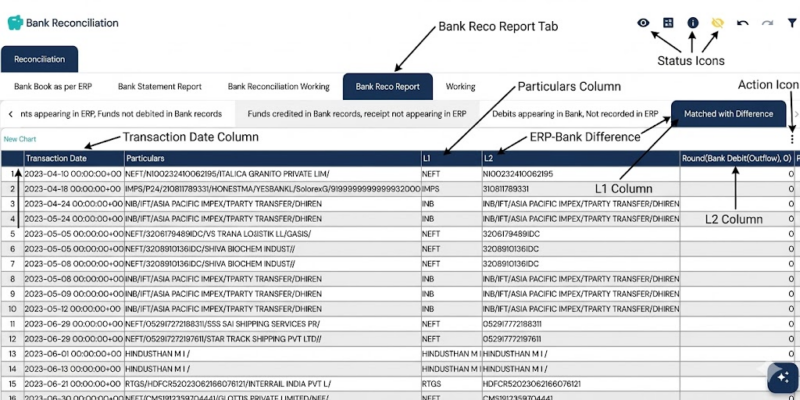
By using a bank reconciliation solution, finance teams and organizations can reap the benefits.
1. Time efficiency and savings
Automation significantly decreases the time needed for reconciliation. Things that used to take several days can now be done in minutes.
2. Improved Accuracy
These solutions would reduce humane errors and ensure more reliable financial records by minimizing human intervention.
3. Better Financial Visibility
Real-time updates would provide a clear view of cash flow, account balances and outstanding transactions thus enabling decision-making.
4. Faster Month-End Close
Automated reconciliation would advance financial closing processes thus helping organizations meet deadlines efficiently.
5. Enhanced Fraud Detection
These tools would quickly identify unusual transactions or discrepancies while helping detect fraud early.
6. Stronger Compliance and Audit Readiness
Businesses would be able to ensure compliance with regulatory standards and simplify audits with built-in controls and audit trails.
7. Cost Reduction
Reducing manual effort and errors will lower operational costs and minimize the financial risks.
How to Choose the Right Bank Reconciliation Solution
Business requirements would determine the suitable solution selection. A few factors should keep in mind.
- Volume of transactions: High-volume businesses will require advanced automation and scalability as per transaction volume.
- Integration capabilities: Ensuring it would integrate into the existing enterprise resource planning and accounting systems.
- Customization: Find rule-based matching and flexible workflows.
- Real-time capabilities: Look for solutions that provide real-time insights.
- Compliance requirements: Make sure that the tool complies.
- Ease of use: A user-friendly interface reduces the training period thus enhancing adoption
Conclusion
A modern bank reconciliation solution is no longer just a back-office tool but rather a financial management asset. These solutions would empower finance teams to focus on higher-value tasks such as analysis and decision- making.
As businesses continue to expand and financial operations become increasingly complex, the right bank reconciliation solution can make operations more efficient, reduce risks and promote financial transparency.
FAQ
- What is a bank reconciliation solution and why is it important?
A bank reconciliation solution is said to automate the matching of a company’s financial records to the bank’s statement. It’s important as it will guarantee accuracy, detect discrepancies, prevent fraud and improve overall financial control.
- How does a bank reconciliation solution improve efficiency?
A bank reconciliation solution would improve efficiency by automating data imports, data transaction matching and exception handling. This would reduce manual work, speeds up reconciliation processes and allow finance teams to focus on strategic tasks.
- Can small businesses benefit from a bank reconciliation solution?
Yes, small businesses would benefit hugely from a bank reconciliation solution. It would help them save time, reduce errors, maintain accurate financial records and gain better visibility into cash flow without requiring large finance teams.
