
In present day financial environment which changes rapidly, the organizations would be looking for ways to improve efficiency, reduce manual workloads and accelerate cash flows increasingly. One such area where rapid transformations would be happening is accounts receivable. The organizations depend manually on processes, spreadsheets and reconciliation tasks which would be time-consuming. Due to this, the AR departments would be including advanced technologies to streamline their operations. This is where AI in accounts receivable is emerging as a powerful driver of change among these innovations.
Artificial intelligence would redefine how businesses would manage receivables by automating repetitive tasks, improving accuracy and providing predictive insights. Be it invoice processing to payment forecasting, by integrating AI finance teams would be able to operate more strategically while improving their overall financial health.
The Traditional Accounts Receivable Landscape
The accounts receivable function of organizations relied heavily on manual processes for decades. The accounts receivable teams were responsible for issuing invoices, tracking payments, matching disputes and following up with customers for outstanding balances. Since these processes were critical to maintain healthy cash flow, they were slow, labour-intensive and susceptible to human error.
It can take hours, even days, of work to match and reconcile invoices manually, particularly for those with a large number of transactions. Moreover, limited knowledge of customer payment conduct posed challenges for the finance teams in foreseeing delays or spotting potential problems.
Inconsistencies would lead to increased day sales outstanding (DSO) which in turn lead to delayed inflow of cash and tension in customer relationships. As businesses would scale and transaction volumes would increase, it became clear that traditional AR processes would need a more intelligent and automated approach.
The Evolution Toward AI-Powered Receivables
For an organization, their journey towards AI in Accounts Receivable would begin with the adoption of basic automation tools and digital accounting systems. The early solutions would digitize invoices and automate some reconciliation tasks thus reducing dependency on paper-based workflows.
However, artificial intelligence would have taken this transformation much further. AI systems would analyse large volumes of financial data, learn patterns from historical transformations and would continuously improve decision-making process.
The modern AR platforms would integrate machine learning algorithms, natural language processing and intelligent data recognition to automate complex tasks that previously required human intervention. Such development would allow organizations to move from reactive receivables management to proactive financial strategies.
Key Applications of AI in Accounts Receivable
The AI integration would enhancing multiple aspects of the accounts receivable process. These capabilities would not only improve operational efficiency but would also provide deeper financial insights.
1. Intelligent Invoice Processing
AI in accounts receivable would automatically capture and extract data from invoices, emails and payment records. The system would identify key details such as invoice numbers, amounts and payment terms.
This would eliminate the need for manual data entry and would significantly reduce the risk of errors. The finance team would process large volumes of invoices in minutes instead of hours.
2. Automated Cash Reconciliation
Traditionally matching incoming payments with corresponding invoices has been one of the most time-consuming AR tasks. AI would simplify this process by analysing remittance data, bank statements and historical patterns would automatically match payments to open invoices.
Companies would be able to achieve faster and more accurate cash application thus improving financial visibility and reducing reconciliation delays with AI in Accounts Receivable.
3. Predictive Payment Forecasting
Artificial intelligence can analyse customer payment histories, seasonal trends and external economic factors to predict when invoices are likely to be paid. These insights enable finance teams to forecast cash flow more accurately and plan working capital strategies accordingly.
The artificial intelligence would analyse customer payment histories, seasonal trends and external economic factors to predict when invoices would likely to be paid. These insights would enable finance teams to forecast cash flow more accurately and plan working capital strategies accordingly
Predictive forecasting would also help organizations identify high-risk accounts that may require proactive follow-up.
4. Smart Collections Management
AI tools would prioritize collection activities based on customer payment behaviour and risk profiles. Instead of sending generic reminders, the system would recommend the most effective communication strategy for each customer.
For instance, AI would suggest sending a reminder earlier for a customer who frequently delays payments or recommends a different follow-up approach for high-value accounts.
5. Dispute Detection and Resolution
The disputes would significantly delay payments and increase administrative workloads while AI systems would identify potential disputes by analysing transaction patterns and communication history. The early detection would allow AR teams to resolve issues quickly before they would escalate into long payment delays.
Efficiency Gains from AI in Accounts Receivable
The adoption of AI in Accounts Receivable would deliver measurable efficiency improvements across financial operations.
Improved Processing Speed:
Automation would reduce the time required for invoice processing, cash application and reconciliation. The tasks that would once take hours would be now completed within seconds.
Reduced Operational Costs:
Organizations would be now able to significantly reduce administrative costs associated with AR management by minimizing manual work and errors.
Enhanced Accuracy:
Minimizing human errors in data entry and payment matching would be possible as AI systems would apply consistent validation rules.
Better Cash Flow Visibility:
Finance teams would be able to give a clear view of outstanding receivables, expected payments and potential risks with the help of real -time dashboards and predictive analysis.
Stronger Customer Relationships:
Timely and accurate invoicing, combined with smarter collections strategies would improve communication with customers and reduces payment disputes.
Challenges in Implementing AI in Accounts Receivable
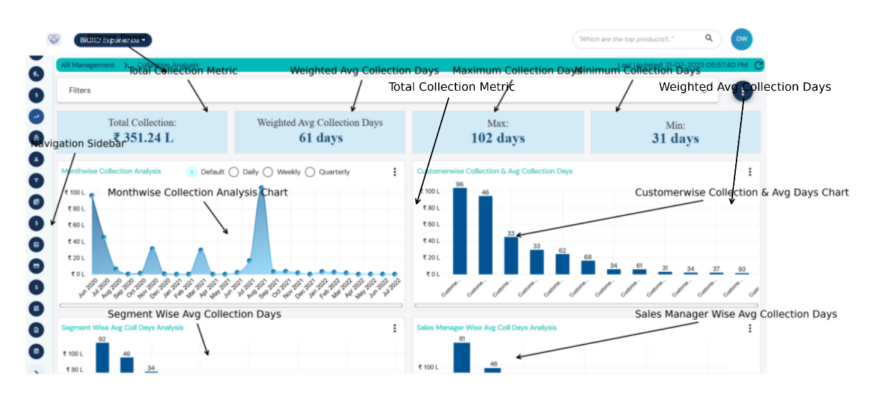
Implementing AI in accounts receivable as a solution will come with some challenges, despite its benefits. Organizations must have good quality data to run AI models as the reliability of predictions and automation can be impacted by flawed data.
Another consideration will be integration with current accounting systems. Businesses will often still rely on legacy software and migrating this to AI-powered platforms will require careful planning.
Additionally, finance teams will require formal training to understand and use AI in accounts receivable. It won’t be the technology that determine whether adoption will be successful or not but the organisational readiness and process alignment.
The Future of AI in Accounts Receivable
The future of Artificial Intelligence in Accounts Receivable will be even more transformational. As artificial intelligence models keep improving, augmented-reality systems will become progressively more autonomous and capable of managing complex decisions with limited human intervention.
New innovations including conversational AI assistants, payments insight in real time and embedded finance will further empower receivables management. The focus of financial teams will now change from routine admin work to strategic financial planning and relationship management.
Businesses which would adopt AI in accounts receivable in the near future would gain advantages like improvement in cash flow, operational efficiency and customer satisfaction.
Conclusion
Management of accounts receivable is seeing a big change thanks to artificial intelligence. The process which used to be manual and reactive is becoming intelligent, automated and predictive.
If organizations would start using AI in Accounts Receivable, their invoice processing will be faster, cash application quicker, forecasting will improve and collections strategy will be enhanced. As a result, cash flow is faster, operational costs are lower and financial control is tighter.
In the future, AI would play a vital role in the financial operations due to business continuing to embrace digital transformation. Companies that would leverage these technologies today will be better positioned to manage growth, optimize cash flow and build more resilient financial systems.
