
The finance leaders in today’s dynamic business environment are under increasing pressure to manage liquidity, mitigate risks and maintain real-time visibility over cash flows. The treasury departments in an organization plays a central role in achieving these goals yet many organizations continue to rely on manual spreadsheets and disconnected systems to manage critical treasury operations. As financial transactions would grow in volume and complexity, the traditional methods would often struggle to keep pace.
This is where Treasury management automation would become strategic. Financial position would be more transparent and visible when treasury processes are streamlined with technology. The organizations can improve efficiency and enhance accuracy. Treasury operations automation will help in a reduction in the administrative burden thus empowering finance to focus on important decision-making.
Understanding Treasury Management
The treasury management would involve overseeing a company’s liquidity, financial risk, investments and banking relationships. The treasury teams would ensure that the organization has sufficient cash to meet its obligations while optimizing the use of available funds.
The key treasury responsibilities would include:
- Cash flow monitoring and forecasting
- Bank account management
- Payment processing
- Risk management and compliance
- Investment and liquidity planning
When these tasks would be handled manually, they could become time- consuming and prone to errors. The manual reconciliation, fragmented data sources and delayed reporting would often prevent treasury teams from gaining a clear, real-time picture of their financial standing.
The Shift Toward Automated Treasury Management
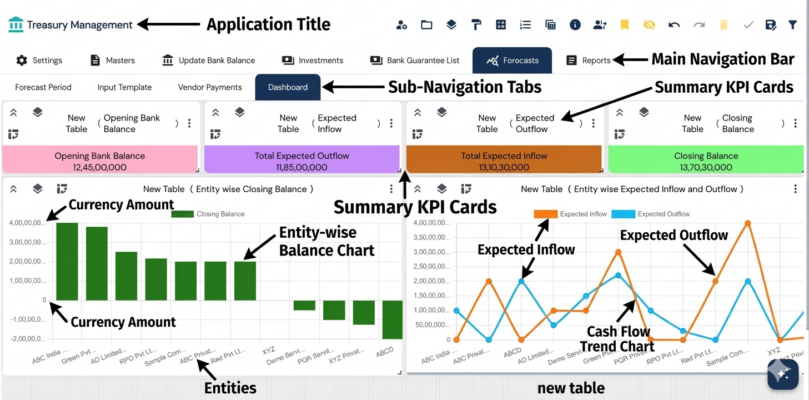
With financial technology advancing every day, many organizations would transition from manual treasury processes to automated treasury management systems. These solutions would integrate banking data, financial transactions and reporting tools into a centralized platform.
The treasury teams would be able to access real-time information through automated dashboards and workflows instead of relying on multiple spreadsheets or manual updates. Complex transactions like such as bank reconciliations, payment approvals and liquidity tracking would be simplified with the help of automation.
As a result, finance teams would be able to operate more efficiently while maintaining greater control over financial operations.
Key Benefits of Automated Treasury Management
1. Improved Operational Efficiency
The ability to eliminate repetitive manual tasks is one of the most significant advantages of automated treasury management. The processes such as bank data collection, transaction matching and reconciliation can be automated using intelligent systems.
The treasury teams would be able to complete such tasks in minutes instead of hours with the help of automation. This efficiency would not only reduce operational workloads but would also enable finance professionals to dedicate more time to strategic activities such as financial planning and risk assessment.
2. Real-Time Cash Visibility
For effective financial management, maintaining accurate visibility into cash positions is essential. The manual systems would often provide outdated information would because they would depend on periodic updates.
The automated treasury solutions would consolidate banking and financial transactions in real time thus giving organizations a clear view of their cash positions across accounts, subsidiaries and regions. The finance teams would make faster and more informed decisions regarding payments, investments and liquidity management with Treasury management automation
3. Enhanced Accuracy and Reduced Errors
The manual treasury operations would be vulnerable to human errors such as incorrect data entry, duplicate transactions or reconciliation mistakes. These errors would lead to inaccurate financial reporting and potential compliance issues.
If automation happened then these risks would get mitigated to a great extent as rules and checks can be applied treasury-wide. Transactions which would be processed through automated treasury management would ensure correctness and consistency in processing transactions as compared to manual processing system. It will reduce inconsistencies and enhance reliability.
4. Better Cash Flow Forecasting
It would become increasingly important to forecast cash flow for liquidity and future operations. However, due to manual forecasting methods based on old or limited information, they would make forecasts with less actual data.
Through the automated treasury management, the organizations will be able to utilize real-time financial data and predictive analysis. This will lead to enhanced accuracy of forecasts. The cash flow projections provided by the automated systems would be based on historical transaction patterns, payment schedules and market conditions.
By leveraging such insights, companies can proactively anticipate their liquidity requirements, circumvent cash deficits and effectively allocate resources.
5. Stronger Risk Management and Compliance
The treasury departments of any organization would be managing a wide range of financial risks including currency fluctuations, interest rate changes. At the same time, they would have to comply with regulatory requirements and internal financial policy.
The automation can enhance risk management which improves monitoring and control over financial spends. The automated alerts and compliance checks will help identify unusual behaviours or policy violations.
By applying automated treasury management, organizations can enhance their financial governance.
6. Streamlined Banking Relationships
The large organizations would often maintain multiple bank accounts across different regions and financial institutions. Managing such relationships manually would be complicated and inefficient.
The automated treasury platforms would integrate directly with banking systems thus enabling seamless data exchange and transaction processing. The treasury teams would view bank balances, initiate payments and reconcile accounts from a single interface.
Such a centralized approach would simplify banking operations and would improve coordination between finance teams and financial institutions.
Strategic Value for Finance Leaders
The automated treasury management would provide strategic benefits for financial leaders beyond operational improvements. If CFOs and treasury managers of companies had access to real-time data on their cash flow, working capital and liquidity positions, they would easily respond to market volatility, optimize their working capital and support long-term business growth.
Treasury, Accounting and Finance divisions could work better with this automation. When teams have access to accurate financial data, they tend to be more aligned and the financial performance improves.
Challenges to Consider During Implementation
Though the benefits of automation would be substantial, implementing treasury management systems would require careful planning. The chosen online payment solution will integrate with their accounting and ERP package, along with banking systems.
The accuracy and reliability of the system’s data will be a critical factor as automated systems lean on the data to offer insights. Before moving to automated systems, businesses ought to set up strict data governance practices.
Training and change management would also be essential. The treasury teams should understand how to use new tools effectively to fully realize the advantages of automation.
The Future of Treasury Automation
Treasury management in the future would be digital as well as intelligent. The automation of treasury operations is getting fortified with advanced technology like AI and advanced analytics.
In the future, treasury teams will be able to analyse data in real-time, allowing them to predict financial risks, optimize liquidity strategies and make other financial recommendations.
The organizations that would adopt automated treasury management today would be better prepared to navigate financial uncertainty and capitalize on new opportunities.
Conclusion
Treasury management is a crucial function that would directly impact an organization’s financial stability and growth. However, traditional manual processes would limit efficiency, increase risks and would reduce visibility into financial operations.
Incorporating Treasury management automation can help streamline treasury workflows, improve cash visibility, enhance forecasting accuracy and strengthen financial controls for businesses. By automating routine tasks, finance teams would be able to step up from admin work to value-adding work that would benefit the business.
Organizations would not just enhance their operational efficiency by automating treasury operations but also leverage a critical financial practice positioning themselves for success in an era where speed, accuracy and insight will be essential.
