
The treasury teams in an increasingly complicated financial environment would be expected to do more than just manage liquidity. They will have to drive strategic decision-making, mitigate risks and ensure financial stability. However, traditional treasury processes would often struggle to keep up with these demands due to fragmented systems, manual workflows and limited visibility.
Treasury management automation would be a solution to the above struggles. The modern treasury management system will be evolving rapidly, powered by automation, artificial intelligence and real-time data capabilities. But with so many solutions available in the market, what would truly set the best treasury management system apart?
Let’s explore the key features and capabilities that would define a best-in-class treasury management system.
Key features of Treasury Management System
1. Real-Time Cash Visibility and Centralization
Managing cash efficiently is one of the critical functions of any treasury team. The best treasury management system would be to provide a centralized platform that would consolidate financial data across bank accounts, entities and geographies.
With automated treasury management, organizations would be able to gain:
- Real-time visibility into global cash positions
- Consolidated dashboards for better decision-making
- Reduced reliance on spreadsheets and manual tracking
This level of transparency would allow treasury teams to make faster and more informed decisions especially in dynamic market conditions.
2. Seamless Bank Connectivity
An exceptional automated treasury management system would offer robust integration with multiple banks and financial institutions. Users would be able to access all their banking data within a single interface instead of manually logging into different banking portals.
The key capabilities would include:
- Retrieval of bank statement would be automated
- Payment processing would be automated
- The transactions would be real time
Automated treasury management would ensure that data flows seamlessly between systems, eliminating delays and reducing operational risk.
3. Advanced Cash Forecasting
Accurate cash forecasting would be essential for maintaining liquidity and planning investments. The traditional forecasting methods would often depend on static data and assumptions thus leading to inaccuracies.
The optimal treasury management solutions would have automated treasury management to:
- Examine past information and patterns.
- Include real-time insights from various departments.
- Help create cash flow forecasts that are dynamic and accurate.
With this, treasury teams can forecast when cash will fall short or exceed requirements and act sophisticated reporting and analytical tools
4. Automation of Routine Tasks
In treasury operations, manual processes would be one of the biggest bottlenecks. From bank reconciliations to payment approvals, these tasks would be time-consuming and prone to errors.
A top-tier treasury management system would use treasury management automation to streamline:
- Payment processing and approvals
- Bank reconciliations
- Intercompany transactions
- Compliance reporting
By automating repetitive tasks, treasury teams will be able to focus on strategic activities such as risk management and financial planning.
5. Scalability and Flexibility
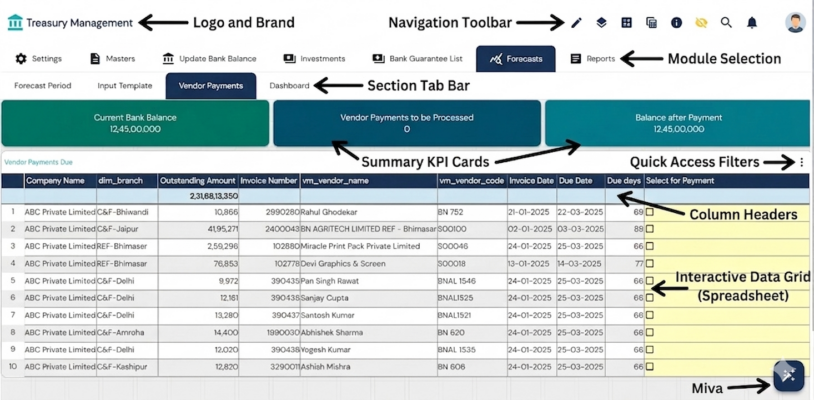
As businesses would grow, their treasury needs will become more complex. A high-quality treasury management system must be scalable enough to support expansion while remaining flexible to adapt to changing requirements.
Key attributes would include:
- Multi-entity and multi-currency support
- Customizable workflows and dashboards
- Easy integration with multiple ERPs and accounting systems
Automated treasury management would ensure that the system will evolve alongside the organization without requiring major overhauls.
6. Data Security and Compliance
Security would become a top priority for treasury management systems given the sensitive nature of financial data. The best solutions would be built with robust security frameworks and compliance standards.
The essential features would include:
- Role-based access controls
- Data encryption and secure authentication
- Audit trails and regulatory compliance
With automated treasury management, compliance processes would be streamlined thus reducing the risk of errors and ensuring adherence to regulations.
7. Intuitive User Experience
Even the most powerful system can fall short if it is difficult to use. A standout treasury management system will offer a user-friendly interface that would simplify complex processes.
This would include:
- Easy-to-navigate dashboards
- Visual data representation through charts and graphs
- Minimal training requirements for users
Automated treasury management will enhance usability by reducing manual inputs and providing actionable insights in a clear format.
8. Integration with Emerging Technologies
The best treasury management system would not just be automated but they would be intelligent. They would leverage emerging technologies such as artificial intelligence to enhance performance.
Capabilities may include:
- Predictive analytics for cash flow and risk
- AI-driven anomaly detection
- Smart recommendations for financial decisions
By incorporating these technologies, automated treasury management would transform treasury functions into a strategic powerhouse.
9. Enhanced Decision-Making Through Analytics
The core of modern treasury operations would be data and the ability to analyse and interpret data effectively is what would separate average system from exceptional ones
Top treasury management system platforms would provide:
- Advanced reporting and analytics tools
- Key performance indicators (KPIs) metric
- Insights in real-time for planning strategically.
With automated treasury management, decision-makers would enjoy accurate and timely information thus enabling them to act with certainty.
Why Automated Treasury Management Is a Game-Changer
The ability of treasury management system to automate and optimize processes end -to-end would be the defining factor. Automated treasury management would not just be about efficiency, it’s about transformation.
It would allow organizations to:
- Lower operating expenses.
- Make improvements in accuracy as well as reliability.
- Improve strategy decision-making.
- Fortify your financial stability.
In a world where financial agility would be critical, automation would give organizations a competitive edge.
Conclusion
The right treasury management system will significantly affect the financial performance of an organization. The top systems will stand out, not just because of the features that they offer, but through automation, intelligence and scalability that would deliver real value.
Treasury management automation could enable businesses to transcend traditional boundaries and achieve new levels of efficient and insightful performance. Since the treasury functions would continue to develop, investing in a robust and future-ready treasury management system would become essential and no longer an option for growth.
