Background
A retail company having more than 400 stores across India.The company’s customers use several methods to pay such as UPI, card swipe, wallet, cashback and cash. Each of these payment modes would move through a different path before the money would reach the company’s bank account. UPI and card payments would go through payment gateways and settle in batches while wallet payments would follow a separate settlement process. The cashback transactions would involve a deduction that will have to be tracked separately from the sale amount as compared to cash which would be physically deposited by each store.
Current Situation
A team of 20 people worked on bank reconciliation before the current solution was introduced. Their job was to match the cash which was received through each payment mode with what showed up in the bank statement. This work would happen every day, across more than 400 stores and across five separate payment modes as the data for each mode would come in a different format and on a different schedule, the team would have to check each source one at a time. The full reconciliation cycle for all stores and all payment modes would take 11 days to complete.
This would mean that when a store would deposit differential cash than expected or when a UPI or wallet settlement would not match the sale, the mismatch would be found many days after it would have happened. By the time, the finance team would notice a gap, the transaction details would be harder to trace and the chance to correct the issuer would have passed by then.
The repetitive nature of work used to create problems within the team as it involved checking the same type of data day after day and came with constant pressure to close the reconciliation within a fixed number of days. This would lead to a lot of attrition in the bank reconciliation team as employees would find the work monotonous and the time-bound pressure, difficult to sustain over time. Every time someone would leave, the company would have to spend time hiring a training a replacement which would add further delays and made the 11-day cycle even harder to maintain consistently.
Problem to Solve
The company wanted to bring the 11-day cycle down to the shortest time possible. The target thus decided was T+1 which would mean that reconciliations for a given day’s transaction would be completed by the next day. The company wished to have store-level governance along with speed which would mean that each store’s cash handling and deposits would be needed to be tracked and reported individually so that any store falling behind on deposits would be identified right away.
BiCXO Solution
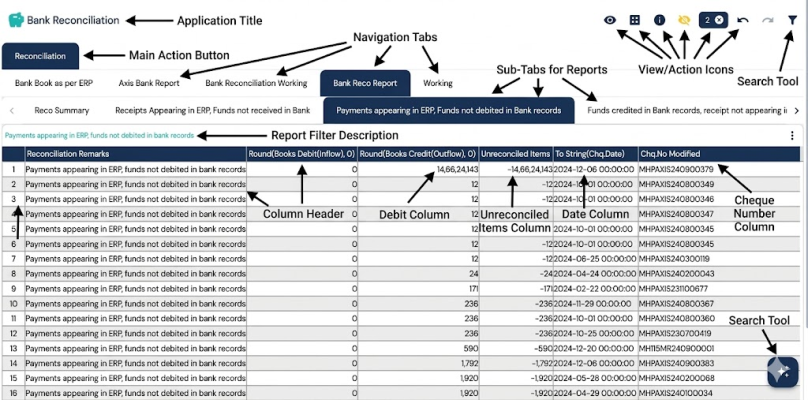
Bicxo team began by studying the company’s bank reconciliation process from start to finish. This would include how a sale was recorded at the store, how each payment mode would be settled with the bank and how the finance team would match these records manually. Once this process was mapped, Bicxo’s bank reconciliation solution would connect directly to the bank APIs for UPI, card swipe, wallet and cashback transactions. The bank reconciliation automation would allow transactions data to flow in automatically without the team having to download files or check emails from the bank each day.
With bank reconciliation automation, the system would pull transaction and settlement data from the bank on its own, match it against store-level sales data for each payment mode and show any mismatch as soon as it would appear. The finance team would no longer need to manually check each payment mode one by one.
Outcome
With this bank reconciliation solution in place, the 11-day cycle has now become a T+1 cycle. Bank reconciliation for each day’s transactions was completed by the next day. With the help of bank reconciliation automation, an automatic mail was sent to store manager every day telling them exactly how much cash would be needed to be deposited in the bank, based on the reconciled numbers from that day.
This changed the way the finance team worked. The repetitive manual matching that had caused attrition was removed from the team’s daily routine and the team could instead focus on exceptions and reviewing flagged mismatches. The company moved from a setup where problems were found after they happened to the one where cash handling was tracked and managed store by store, every day.
