
Introduction
If a CFO is asked how much cash would the business have in 30 days, their honest answer would involve three teams, 2 spreadsheets and a fair amount of guesswork. The treasury would know today’s bank balance, FP&A would have a forecast built last week, Accounts receivable would know which invoices are overdue and accounts payable would know which payments are due but none of these views would talk to each other in real time.
This is the state of fund management in most businesses: accurate within each silo, but disconnected across them. In a function where the entire point is to know the cash position of the company with confidence, that disconnection is the problem.
A connected treasury would change this by bringing fund management, FP&A, Accounts receivable and accounts payable into a single platform, where every piece of data affecting cash is visible in one place, updated continuously and used to make decisions in real time rather than after the fact.
The Problem: Cash Decisions Made on Incomplete Information
Each function individually would do its job well. The trouble will start when decisions require information that would live in more than one of them which, in the case of fund management is present always.
Consider a simple treasury decision: should the business pay a large supplier invoice early to capture a discount, or hold the payment to preserve liquidity for an upcoming requirement? Answering this well requires accounts payable’s view of the invoice and discount terms, account receivable’s view of expected collections in the same window, FP&A’s forecast of other commitments and treasury’s current cash position all at once.
In most organisations, getting this answer would mean pulling data from four systems, reconciling timing differences and presenting a recommendation that’s already a day or two old by the time it’s discussed. The data exists but it’s just not connected.
This disconnection would create blind spot. Accounts receivable teams would chase collections without knowing whether cash is urgently needed. Accounts payable teams would schedule payments without visibility into incoming receipts. FP&A would build forecasts using data that’s already stale by the time it reaches treasury. Each team would optimise its own piece but no one sees the whole picture at once.
The Solution: One Platform, One Continuous View of Cash
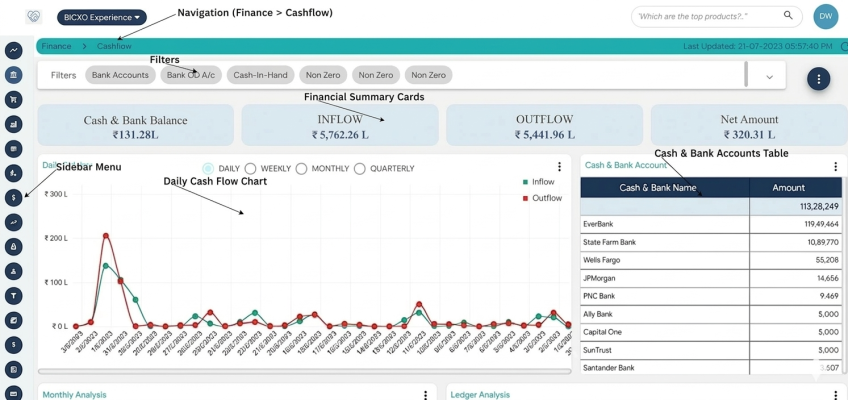
A connected treasury platform would bring fund management, FP&A, Accounts receivable and Accounts payable onto shared, real-time data, so every decision is made with the complete picture, not a partial one.
Cash positions update as Accounts receivable and Accounts payable move. The moment an invoice is raised, collected or a payment scheduled, the impact would reflect immediately in treasury’s cash position no waiting for end-of-day exports or manual updates.
Forecasts stay current automatically. FP&A’s cash forecast would be no longer a static model rebuilt periodically but it would continuously refresh using live account receivable and accounts payable data, giving fund management a forward view that’s always accurate to the latest information.
Cross-functional decisions happen in one view. Early payment discounts, collection prioritisation and short-term fund deployment decisions can all be evaluated against the same live data by the people who need to make the call.
Working capital becomes a single, shared metric. Rather than each function tracking its own version of “how much cash do we have,” everyone from the accounts receivable analyst to the CFO would see the same number, updated continuously.
The result would be fund management that would operate with full visibility, not partial views stitched together after the fact.
Conclusion
The biggest constraint on most treasury teams isn’t a lack of data it’s that the data would exist in places that don’t talk to each other. A connected treasury would solve this not by adding more reports, but by removing the silos altogether.
When fund management, FP&A, Accounts receivable and Accounts payable operate on one continuously updated platform, cash decisions would stop being reactive guesses based on yesterday’s numbers and become confident calls based on today’s reality. For finance leaders aiming to run a tighter, faster, more precise treasury function, connection is not just automation it is the foundation everything else is built on.
Frequently Asked Questions
Q1. What does “connected treasury” actually mean in practice?
It means fund management, FP&A, Accounts receivable and Accounts payable would all draw from and update the same underlying data in real time, instead of operating as separate systems reconciled periodically. A change in one area such as a payment received, an invoice raised, a forecast update which is immediately reflected everywhere else that depends on it.
Q2. Does connecting these functions mean restructuring our finance team?
No. A connected treasury platform would change how data flows between functions, not who does the work. Accounts receivable teams still manage collections, Accounts payable teams still manage payables and FP&A still owns forecasting but each team would operate with visibility into how their work affects and is affected by, the others, making fund management decisions faster and more accurate.
Q3. How does this improve fund management specifically, beyond just convenience?
Fund management depends on knowing exactly how much cash is available, for how long and what’s coming in or going out. When accounts receivable, accounts payable and FP&A data feed into the same platform as treasury, fund management decisions like deploying surplus cash or timing a payment would be based on the actual, current state of the business, not estimates that may already be outdated.
