Why Expense management gets harder with every new store
The first store is always the easiest to run, you know every vendor, every recurring cost, every line item on the P&L. But the moment a retail chain would expand to a second, fifth or twentieth location, expense management will stop being simple, it would become one of the biggest hidden risks to profitability.
Each new outlet would bring its own rent, utilities, local vendor contracts and petty cash flows. Multiply that across 10 or 50 locations and finance teams will be managing expense management not as one P&L, but as dozens of overlapping ones often with no single source of truth.
The Problem: Expense management breaks down across locations
For most multi-location retail chains, expense management challenges show up in a few predictable places.
Inconsistent store-level spending. Without centralised expense management, each store manager would make independent purchasing decisions local vendors, ad-hoc supplies, varying price points for the same expense category with no policy tying it together.
Petty cash with no real-time visibility. Petty cash remains one of the least controlled areas of retail expense management. Store-level cash spends would be often recorded on paper, reconciled weeks later by which point leakage or misuse is difficult to trace back.
Delayed consolidation. Head office finance teams would typically only get a consolidated expense management view at month-end. Cost overruns at an individual location would stay invisible until the damage has compounded across a full reporting cycle.
Vendor fragmentation. Each location would often manage its own local vendors for the same expense categories cleaning, security, repairs thus leading to wide price variation and no leverage for chain-wide negotiation.
Individually, these gaps would seem minor at the store level. Across a growing network, they would add up to real margin erosion and a finance team will always reconcile the past instead of managing the present.
The Solution: Centralised, Real-Time Expense Management
The retail chains scaling profitably would treat expense management as a centralised, real-time function rather than a store-by-store afterthought.
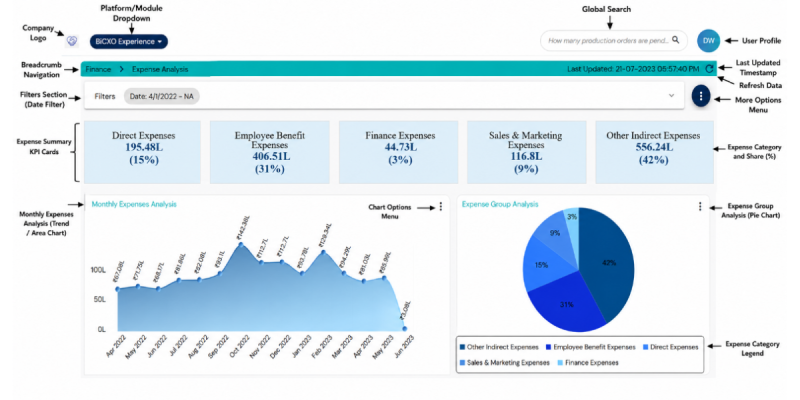
A single expense management dashboard across all locations would give finance leaders live visibility into spending by store, category and vendor thus replacing the month-end surprise with daily awareness.
Standardised expense policies would ensure every store follows the same approval thresholds by removing the inconsistency that would come from manager-level discretion.
Digitised petty cash tracking will bring real-time accountability to small, frequent spends with the category most prone to silent leakage in distributed retail expense management.
Vendor spend analytics across the chain would reveal where the same expense category, which is being paid differently across locations thus creating opportunities for centralised negotiation and savings.
Conclusion
Every new store a retail chain opens should add to profitability not to dilute the management control over costs. Strong expense management is what separates a chain that would scale profitably from one that would grow revenue while quietly losing margin at the store level. The earlier a chain would centralise expense management, the more sustainable its growth becomes.
