Financial analysis has always helped businesses in strategic decision-making, risk management, growth and ensuring sustainable growth. They have relied on traditional methods like spreadsheets and manual processes to analyse financial performance for decades. Such approaches would have served their purpose once but with growing data volumes, complex business models and the need for real-time insights their limitations have been exposed.
This is where Financial Analytics Softwarewould emerge as a game-changer. By automating calculations, consolidating data and providing advanced analytical capabilities, modern financial tools would transform how finance teams will operate. This blog would compare financial analysis software with traditional spreadsheet and manual methods to help business understand which approach would best support their financial goals.
Understanding Traditional Financial Analysis Methods
Spreadsheet-Based Financial Analysis
For financial analysis, spreadsheet has been crucial as it would offer flexibility, familiarity and the ability to build customized models for budgeting, forecasting and performance analysis. Many finance professionals would be comfortable using formulas, pivot tables and macros to derive insights from data.
However, as data would grow, spreadsheet-based analysis would become more complex. The large spreadsheets would be prone to formula errors, version control issues and limited collaboration. As multiple stakeholders would access and update files, maintaining accuracy and consistency would become challenging.
Manual Financial Analysis
Manual analysis would involve collecting data from various sources, performing calculations by hand and preparing reports without automation. Such method is usually used by smaller organizations or teams with limited resources.
Manual processes would usually appear to be cost- effective but they are time-consuming and highly dependent on individual expertise. Errors, delays and lack of scalability would often outweigh the perceived benefits.
What Is Financial Analytics Software?
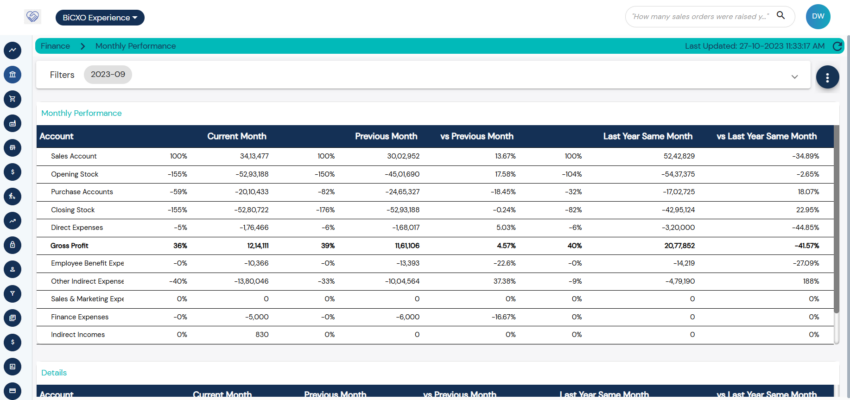
Financial analytics software would refer to advanced digital tools used to automate, analyse and visualize financial data in real time. These platforms would integrate data from multiple sources such as ERP, accounting, banking and CRM. With the integrated data, the software would transform them into actionable claims.
The key capabilities of the software would include automated reporting, forecasting, scenario analysis, variance analysis, dashboards and predictive analytics which would be powered by AI. Unlike traditional methods, financial analytics software would provide a centralized, accurate and scalable approach to financial analysis.
Key Comparison: Financial Analysis Software vs Spreadsheet & Manual Methods
Accuracy and Error Reduction
The traditional methods would rely heavily on manual inputs and complex formulas. A single incorrect cell reference in Spreadsheet would develop major reporting inaccuracies. The manual calculations would increase the risk of human error even further.
The financial analytics software would significantly reduce errors by automating calculations and standardizing data inputs. The built-in validations checks and audit trails would ensure data integrity thus making insights would more reliable for decision-makers.
Time Efficiency and Productivity
Manual analysis and spreadsheet-based reporting would often require hours ore even days to compile data, reconcile numbers and update reports. This would limit the finance team’s ability to focus on strategic analysis.
The financial analytics software would automate repetitive tasks such as data consolidation, reconciliation and report generation. As a result, the finance teams would be able to shift from data preparation to value-driven activities like forecasting, scenario planning and strategic advisory.
Real-Time Insights and Agility
The spreadsheet files would be typically static and updated periodically while manual processes would offer no real-time visibility thus making it difficult for businesses to respond quickly to changing market conditions.
In contrast, the financial analytics software would provide real-time dashboards and live data feeds. The decision-makers would instantly track cash -flow, profitability and performance metrics thus enabling faster and more informed responses to risks and opportunities.
Scalability and Data Volume Handling
As businesses would grow, the volume and complexity of financial data would increase. The large spreadsheet files would become slow, difficult to manage and prone to crashes. The manual processes would simply do not scale.
The financial analytics software is built to handle large datasets across multiple entities, geographies and currencies. The software would increase business growth thus making it ideal for mid-sized and large organizations.
Collaboration and Version Control
Spreadsheet-based analysis would often result in multiple versions of the same file being shared across teams. This would create confusion over which version would be accurate and up to date.
The financial analytics software would provide a centralized platform with role-based access, version control and collaboration features. Everyone would work from a single source of truth thus improving transparency and alignment across departments.
Advanced Analytics and Forecasting
While spreadsheet would support basic forecasting, advanced scenario modelling and predictive analysis would require complex formulas and manual effort.
The financial analytics software will use AI and machine learning to create predictive insights, trend analysis and what-if scenarios. It allows finance leaders to predict future results rather than merely report on past performance.
Compliance, Audit, and Security
The reliance on manuals and spreadsheets would often result in weak audit trails and control security. Tracking changes, approvals and historical data would be difficult during audits. The financial analytics program would have automatic compliance features, comprehensive audit traces and high-end security measures. Since this will simplify regulatory reporting, data governance will be enhanced.
When Do Traditional Methods Still Make Sense?
Despite their limitations, Spreadsheet and manual methods may still be suitable for:
The small businesses conducting negligible business transactions Occasional calculations or a one-off analysis Early-stage startups with small budgets
However, even these organizations would often outgrow traditional approaches as complexity increases.
Why Businesses Are Moving Toward Financial Analytics Software
The shift towards the financial analytics software will be driven by the need for speed, accuracy and strategic insight. The future finance teams would be expected to meet as business partners and not just mere number crunchers. They will be able to do so with automation and advance analytics.
The financial analytics software will replace fragmented spreadsheets and manual processes with a solution that would support better decision-making, financial control and long-term scalability.
Conclusion
Although spreadsheet formulation and manual processes would have been a staple in financial analysis, yet they would struggle with today’s fast-paced and data-intensive world. Due to their errors and inefficiencies, limited scalability would make them unsuitable for growth.
The financial analysis software would offer a modern, automated and intelligent alternative which would be delivering real-timer insights, improved accuracy and enhanced strategic value. For businesses aiming to future-proof their finance function, transitioning from traditional methods to financial analysis software would be no longer optional but a strategic necessity.