
Introduction
Most businesses would be sitting on cash they don’t fully use. Visible, accounted for balances sitting in current accounts, earning little to nothing and is not hidden. Meanwhile, the finance team would focus on whether there’s enough cash or whether too much of it is sitting idle.
The above scenario would be one of the quiet inefficiencies of corporate fund management. Surplus cash would be a good problem for the team to have until they realise that the money sitting idle in a low-interest account could be working. At scale, across months and multiple accounts, the opportunity cost of idle cash would add up to a number that would rarely make it into a board discussion,
AI-driven fund management would change this, by continuously identifying surplus cash and automatically deploying it according to pre-set rules, businesses would be able to turn idle balances into a genuine, low-effort source of return without adding risk or complexity to treasury.
The Problem: Surplus Cash That Never Gets a Second Look
The reason idle cash persists isn’t negligence. It’s structural.
Most finance teams would take defensive approach towards cash where the priority would be making sure there’s enough to cover payroll, vendor payments and operations. Once that buffer would be comfortably covered any additional balance would often just stay where it is. Moving it into a short-term instrument would require someone to notice it’s there, calculate how long would it take to be safely deployed, choose an instrument and execute all manual steps that would compete with higher-priority work.
If multiplied this across multiple bank accounts, entities or currencies, the problem would compound. A business with five operating accounts might have surplus sitting in three of them at once but no one would be looking across all five simultaneously to spot the pattern.
There would also be a timing problem. Surplus cash is often temporary as it would be available for two weeks before a large payment is due. Manually identifying and acting on such a short window is rarely worth the effort, so the cash simply sits, while fund management focuses on the next quarter’s bigger decisions.
The result would be a silent drag on returns, an opportunity that would never get surfaced, and therefore never gets captured.
The Solution: Continuous Surplus Detection and Automated Deployment
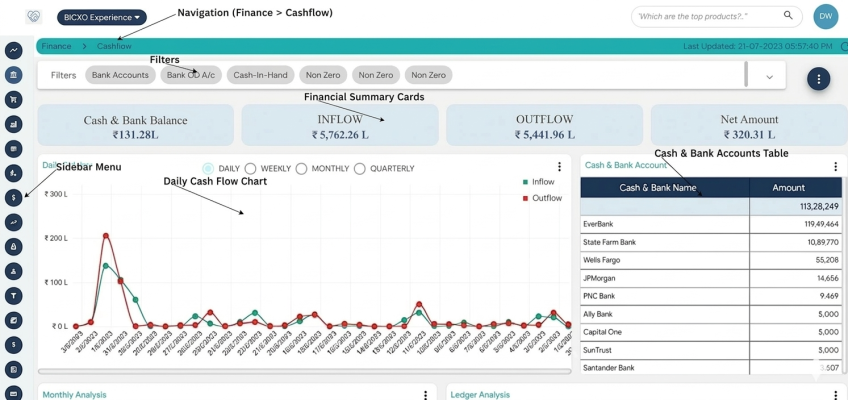
AI-driven fund management would treat cash optimisation as continuous, automated process rather than an occasional manual exercise.
Surplus would be identified in real time. This would be possible by continuously analysing cash positions against forecasted needs which would include upcoming payables, payroll cycles and minimum operating buffers. The system would identify exactly how much cash is genuinely surplus and for how long.
Deployment would follow pre-set rules not ad-hoc decisions. Businesses would be able to define their risk capacity and liquidity preferences with the surplus available for under a week that would go into a one type of instrument and surplus available for a month into another. Once defined, the system would apply these rules consistently without anyone revisiting the decision each time.
Multi-account and multi-entity visibility closes the gap. Instead of surplus being invisible because it would be scattered across accounts, AI-driven fund management would consolidate visibility by showing the true surplus position at a group level, not an account level.
Returns compound without adding operational load. Because deployment and redemption would happen automatically as cash would need shift, the finance team would not trade time for yield. The system would handle the mechanics: the team would simply review performance periodically.
This isn’t about taking on new risk. It’s about ensuring cash that was always going to sit safely somewhere does so in a way that earns something, instead of nothing.
Conclusion
Idle cash would be one of the most overlooked line items in corporate finance, not because it’s hard to fix but because no one has the bandwidth to keep watching for it. AI-driven fund management would remove that bandwidth constraint entirely.
By continuously identifying surplus, applying pre-defined deployment rules and consolidating visibility across accounts and entities, businesses would turn an invisible inefficiency into a quiet, compounding source of return. For finance leaders who are looking for wins that require no new risk, no new headcount and no disruption to operations, automated fund management of surplus cash is one of the simplest places to start.
Frequently Asked Questions
Q1. Is it risky to automatically deploy surplus cash?
Not when done within pre-defined rules. AI-driven fund management would not make independent risk decisions as it would follow parameters the business sets in advance, such as which instruments are acceptable and for what durations. The system’s role is to apply those rules consistently and act on opportunities the moment they appear, not to take on risk beyond what’s already approved.
Q2. How does the system know how much cash is actually surplus?
It would compare current cash positions against forecasted obligations such as upcoming payments, payroll, statutory dues and a defined minimum operating buffer. Whatever remains above that buffer, for whatever time it’s likely to remain available, is treated as surplus. This forecasting accuracy is what would make automated fund management reliable rather than guesswork.
Q3. Does this work for businesses with multiple bank accounts or entities?
Yes, that’s where it adds the most value. Multi-account and multi-entity businesses are exactly where surplus cash tends to go unnoticed because no single person has visibility across every account. AI-driven fund management would consolidate this view automatically, by identifying surplus at a group level and deploying it accordingly, regardless of how fragmented the underlying accounts are.
