
Introduction
For the last two years, ever founder pitch deck has a slide about AI. The finance teams of the companies are told that adopting accounts receivable automation will cut costs, save hours and free up headcount for “strategic work”. But when budgets become tight and harder questions are asked by the investors about burn, a fair challenge emerges: Is this the spend actually paying for itself or is it a well-marketed line item that would add complexity without adding saving? For start-ups deciding whether to invest in accounts receivable automation, the honest answer would be: it depends entirely on how the tool is chosen, implemented and measured.
The Problem
The AI ROI trap usually shows up in one of three ways. First, start-ups adopt accounts receivable automation to solve a vague problem such as “our collections are slow” without defining what faster collections should actually deliver in dollar terms. Without a baseline, there is no way to prove the tool worked. Second, the finance teams would underestimate implementation cost. Accounts receivable automation would still need clean customer and invoice data, defined dunning rules and a finance person who will understand how to interpret its output; skipping this step would mean the system will chase the wrong accounts or flags false positives and the team quietly reverts to manual follow-ups while still paying the subscription. Third, and most common in early-stage companies, the tool is sized for a company twice their scale. A ten-person start-up doesn’t need enterprise-grade accounts receivable automation with modules it will never touch, it would need the two or three features that would remove real manual chasing. When any of these three failures happen, the “AI investment” becomes a sunk cost that founders are reluctant to admit, which is exactly what turns a useful tool into a trap.
The Solution
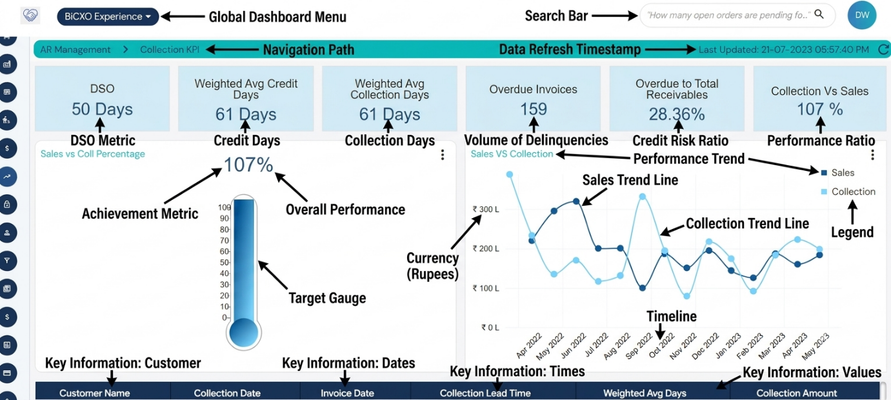
Start-ups that see genuine savings from accounts receivable automation treat it as a measurable operational decision, not a technology purchase. This will start off by specifying which manual task will be replaced by sending payment reminders, reconciling incoming payments, chasing overdue invoices, and how long that currently takes. Make sure to evaluate the accounts receivable automation against that number, not a vendor’s marketing. The clearest ROI shows up in a certain sanity check: a founder who cuts average collection time from 45 days to 25 and removes recurring reconciliation errors that used to trigger customer disputes, can point to a concrete return after all. Start-ups would benefit more from piloting accounts receivable automation on overdue-invoice reminders or payment matching, rather than automating the whole order-to-cash cycle at once. In fact, it is better to expand only once that workflow shows measurable time saved. Ultimately, it’s the human side that counts for ROI: a tool only pays off if the finance team actually uses it instead of keeping its own shadow spreadsheet for who owes what, so tracking adoption matters as much as a feature set.
Conclusion
AI is not inherently an ROI trap for start-ups. In fact, start-ups can often see tangible returns when AI is applied to clearly defined, repetitive operational work by automating processes such as reconciliations, accounts payable, MIS reporting and accounts receivable can reduce manual effort, improve accuracy and lower operating costs without requiring significant headcount. For lean start-ups, the bigger advantage is often founder and team bandwidth. When AI takes over routine tasks that consume hours every week, founders can spend more time on strategy, customers, product, hiring and execution. The real ROI is not just cost savings, it is creating leverage with limited resources.
FAQs
Q1: How can a start-up tell if accounts receivable automation is actually saving money?
The impact can be seen by comparing the time spent on collection tracking, reconciliation and follow-ups before and after automation. When fewer hours are required, errors are reduced and collections are handled more efficiently within the first few billing cycles, the value of accounts receivable automation would become clearly visible.
Q2: Is accounts receivable automation worth it for an early-stage start-up with a small team?
Yes, when it is focused on a genuine operational bottleneck. Accounts receivable automation can be introduced around specific processes instead of covering the entire order-to-cash cycle. This allows lean teams to gain efficiency without taking on unnecessary complexity, while valuable time is freed for growth and execution.
Q3: What’s the biggest reason accounts receivable automation fails to deliver savings?.
The greatest value is achieved when implementation is supported by clean customer and invoice data and proper team adoption. When these foundations are in place, accounts receivable automation can identify outstanding payments, reduce manual tracking and support timely follow-ups. This allows the technology to deliver its intended value instead of becoming another unused subscription
