When Margins Are Thin, Expense Management Can’t Be an Afterthought?
Manufacturing would run on margins and margins depend on knowing where every rupee goes. From the first purchase order to the final delivery, every stage of the supply chain either protects cost or quietly bleeds it.
Yet when it comes to mid-sized manufacturers in India, expense management across the supply chain would be fragmented at best. For example, the finance team would learn what was spent after the money would be gone, operation team would approve the cost in silo while leadership would make procurement decisions on gut feel rather than data. In an environment where cost optimisation has become a top priority going into 2026, weak supply chain expense management would be no longer a minor inconvenience but a competitive liability.
The Problem: Expense Management Breaks Down at Every Stage
A manufacturer’s supply chain would run through procurement, inbound logistics, production, warehousing and distribution. At every stage, expenses would be generated and at each stage, expense management visibility would tend to break down.
At procurement, PO-to-invoice differences would go unnoticed. The maverick purchases
outside approved vendor lists would inflate costs without appearing on any expense
management dashboard until month end.
At inbound logistics, freight, customs and handling charges would be journaled as lump-sum overheads rather than tracked line by line. The finance teams would have no mechanism to flag anomalies or compare actuals against budgeted rates.
At production, indirect expenses such as consumables, contract labour, utilities would be approved departmentally with no cross-functional view. A production head approving a tooling cost would have no sight of what procurement paid the same vendor the previous week.
At warehousing and distribution, storage costs and last-mile charges would be captured only in the accounts, never surfaced in a live expense management view tied to the original budget.
Individually, each gap would seem small but collectively they would keep the finance function permanently reactive always reconciling the past, never steering the future. Further research backs this up by 67% of firms have increased investment in expense management visibility tools, yet fragmented data integration remains the single biggest
barrier to procurement success.
The Solution: Real-Time Expense Management Across the Chain

The shift forward -thinking manufactures would be making is from periodic reporting to continuous expense management intelligence a single, real-time view of costs across every stage.
Centralised vendor would spend in analytics that would give finance and procurement a unified picture of all supplier payments. Duplicate invoices, unapproved vendors and price creep would become visible before they compound into overruns.
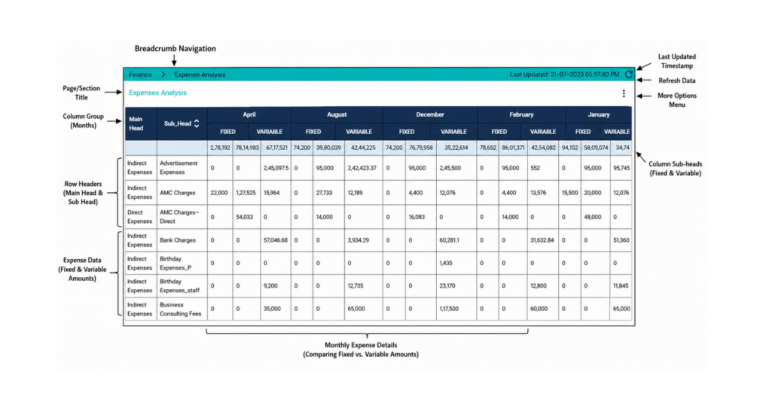
Budget vs. actuals tracking at cost-centre level would make every team procurement, production, logistics accountable to its own expense management envelope with automated alerts replacing end-of-month surprises.
Policy-linked approval workflows would enforce expense management discipline at the point of commitment, not after. Exceptions would be flagged; the right approver is notified instantly and an audit trail is built automatically.
The result is an expense management function that would shift from reporting what happened to preventing what shouldn’t.
Conclusion: Strong Expense Management Is the Real Competitive Edge
The manufacturers winning on margins would not always be those with the lowest input costs but they would be the ones with the clearest expense management picture of where every rupee is going. The supply chain expense management is not a finance nice-to have anymore but currently an operational imperative. The data would be already there. What most manufacturers would be missing is the system that would bring it together.
Frequently Asked Questions
Q1. What is supply chain expense management and why does it matter for manufacturers?
Supply chain expense management would refer to a manufacturer’s ability to track, monitor and control costs at every stage from procurement and inbound logistics to production, warehousing and final delivery. It would matter because most cost overruns in manufacturing don’t stem from one large decision; they accumulate through small, untracked expenses across multiple departments and vendors. Without real-time expense management visibility, finance teams would only react after the damage would be done.
Q2. Which stage of the supply chain has the weakest expense management visibility?
Inbound logistics and indirect production costs would be typically the biggest blind spots in supply chain expense management. Freight, handling and customs charges would be often journaled as consolidated overheads rather than individual line items. Similarly, indirect production expense such as consumables, contract labour, utilities would be approved departmentally with no cross -functional visibility thus allowing costs to compound unnoticed.
Q3. How is supply chain expense management different from general expense management?
General expense management would typically focus on employee-level spending such as travel, reimbursement and office costs. The supply chain expense management is broader as it includes, vendor payments, procurement budgets, logistics charges, production overheads and distribution costs across multiple teams and locations. It would require category-level analysis, vendor spend benchmarking and cost-centre accountability and not just receipt capture and policy compliance
