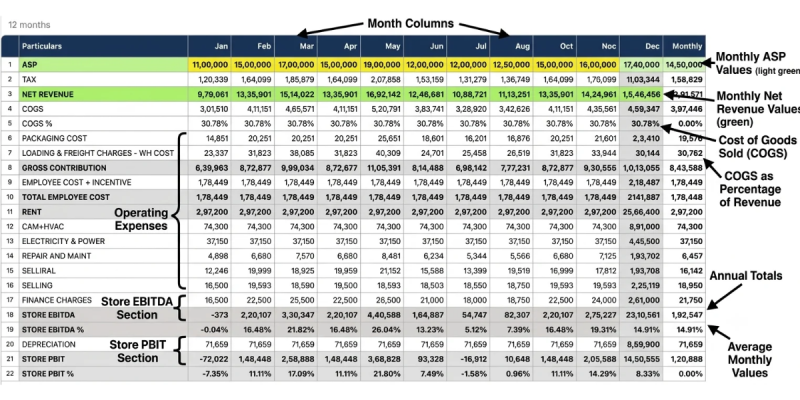
Introduction: AI Driven Finance Forecasting and How Real-Time Finance Actually Works
Real-time finance sounds like a destination, but it is really the outcome of a mechanism working underneath. AI driven finance forecasting is that mechanism: a process where forecasts are built and rebuilt from underlying business drivers rather than static assumptions.
By understanding how AI driven finance forecasting operate would explain finance teams to use it and think and react faster than those relying on traditional models.
The Problem: What’s Missing Without AI Driven Finance Forecasting
Most forecasting models are assumption-heavy because they are built by hand. Without AI driven finance forecasting, finance teams would have the below limitations:
- Assumptions baked in early stay unchanged. A model built on last quarter’s growth rate would stay static until someone manually revisits it, even if underlying conditions shift.
- Driver relationships are oversimplified. Manual models would often use flat growth percentages instead of reflecting how individual drivers, like customer churn or pricing changes, actually interact.
- Rebuilding is slow and error-prone. Every time an assumption needs updating, someone has to manually adjust formulas across a spreadsheet which would increase the risk of mistakes.
- Limited traceability. When a forecast turns out to be wrong, it is often difficult to trace exactly which assumption or driver caused the gap.
These limitations would mean forecasts age quickly and lose credibility, especially in fast-changing conditions where static models fall behind reality within weeks.
The Solution: How AI Driven Finance Forecasting Builds Real-Time Models
AI driven finance forecasting works by modelling forecasts as a function of live business drivers rather than fixed assumptions. As those drivers change, so does the forecast, automatically. This changes how forecasting operates at a mechanical level:
- Driver-based modelling would tie forecasts directly to real inputs, such as pipeline conversion rates or expense trends, instead of static growth percentages.
- Automatic recalculation means that when a driver shifts, AI driven finance forecasting would update the downstream projection without manual intervention.
- Scenario simulation at scale allows finance teams to test many combinations of driver changes simultaneously, rather than manually building separate versions of a model.
- Clear traceability makes it possible to see exactly which driver contributed to a forecast change, making variance analysis faster and more precise.
This is the mechanism that makes real-time finance possible. It is not simply faster reporting; it is a fundamentally different way of building the forecast itself.
How will it help leaders, where they can give a simple prompt and get simulations done (2 para)
Conclusion: AI Driven Finance Forecasting as the Engine Behind Real-Time Finance
AI driven finance forecasting is would be the engine which make finance start thinking in real-time. It would allow projections to update automatically as conditions change by tying forecasts to live business drivers instead of fixed assumptions. For finance teams, this would mean less time spent manually rebuilding models and more confidence that every forecast reflects the current state of the business.
FAQs
1. What makes AI driven finance forecasting different from a standard financial model? AI driven finance forecasting would tie projections directly to live business drivers that update automatically, whereas a standard financial model relies on fixed assumptions that must be manually revised.
2. Can AI driven finance forecasting handle multiple scenarios at once?
Yes. AI driven finance forecasting can simulate many combinations of driver changes simultaneously, giving finance teams a broader view of possible outcomes than manually built scenarios typically allow.
3. Why does traceability matter in AI driven finance forecasting?
Traceability matters because AI driven finance forecasting shows exactly which driver caused a forecast to shift, making it easier to explain variances and adjust plans with precision.
