In retail industry which moves quite rapidly, businesses would have to process hundreds or even thousands of transactions every day. Managing financial records accurately would become challenging as it would involve customer payments, supplier invoices, refunds and online transactions. Even small errors in transactions would match thus create accounting discrepancies, cash flow issues and reporting delays.
The solution to all such problems is a bank reconciliation solution as the retail businesses would improve accuracy, reduce manual work and maintain better control over daily transactions by automating the process of matching bank statements with internal financial records
The Growing Challenge of Daily Retail Transactions
Retails businesses operate in a high-volume transaction environment as payments would be received through multiple channels such as credit cards, UPI, cash, net banking and digital wallets. Managing these transactions manually would often lead to operational difficulties.
Transaction matches is one of the biggest problems retailers would face and with manual reconciliation there would be a possibility of duplicate entries, missing payments or incorrect records. These issues would gradually affect financial reporting and would make it difficult to track actual cash flow.
Time consuming nature of manual reconciliation would be another challenge as finance teams would often spend hours comparing bank statements with invoices, payment records and ERP data. This process would become even more complex, for retailers handling multiple store locations or online marketplaces.
Retail businesses would also face risks related to fraud and unauthorized transactions. Suspicious transactions may go unnoticed thus leading to financial losses without proper monitoring. The delayed reconciliation would further increase the risk of compliance and audit issues.
In addition, inaccurate financial data would impact business decision. The retail companies would rely heavily on daily cash flow visibility to manage inventory, supplier payments and operational expenses. The errors in reconciliation would further increase the risk of compliance and audit issues.
How a Bank Reconciliation Solution Helps Retail Businesses
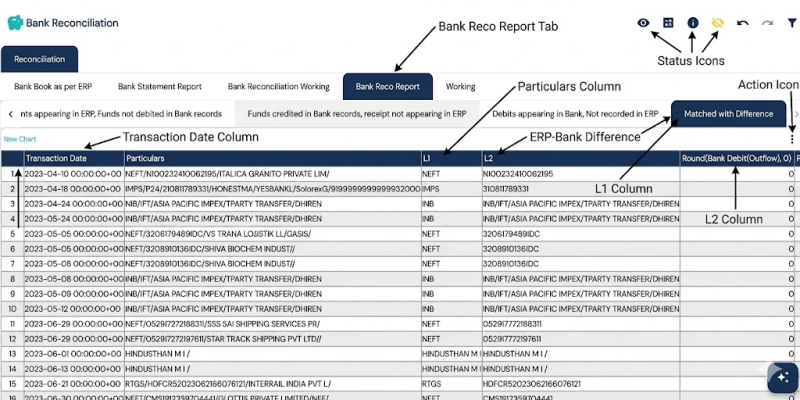
A modern bank reconciliation solution would simplify and automate the reconciliation process thus helping retailers manage daily transactions would more effectively.
Automated transaction matching would be one of the key benefits as the software would automatically compare bank transactions with accounting records thus reducing the need for manual intervention. This would significantly lower the chances of human error and would improve financial accuracy.
Retail businesses would process their transactions through POS systems, e-commerce platforms, digital wallets and multiple payment gateways. A bank reconciliation solution would help retailers consolidate these payment records accurately and reduce mismatches between sales and bank deposits.
Retailers would often face difficulties managing refunds, returns, promotional discounts and seasonal sales spikes. An automated bank reconciliation solution would help such businesses track these complex transaction adjustments more effectively and maintain accurate revenue records.
For multi-store retail businesses, maintaining consistency across different store locations would be challenging. An automated bank reconciliation solution will centralize transaction reconciliation across branches thus helping retailers standardize financial processes and improve operational control.
Centralized reconciliation would become highly valuable for retailers operating across multiple branches or sales channels. The automated bank reconciliation solutions would consolidate transaction data from different payment systems, banks and locations into a single platform which would improve financial transparency and simply reporting.
Moreover, automated reconciliation would support better customer service. The faster payment verification would help retailers would process refunds, returns and customer disputes more efficiently. This would improve customer satisfaction while maintaining accurate financial records.
An automated bank reconciliation solution would also improve payment verification for online and offline purchases. Faster reconciliation will help retailers handle customer disputes, delayed payments and refund claims more efficiently.
Conclusion
Retailers have to reconcile large numbers of financial transactions each day. As so, irrespective of the size of the business, the accuracy of reconciliation is vital in order for it not to interfere with business operations. However, with the growth of a business, manual reconciliation process may often be slow, error-intentional and difficult to manage.
By implementing an automated bank reconciliation solution, retailers can automate transaction matching, improve financial accuracy, detect discrepancies and gain control over cash flow. By improving transaction accuracy across multiple payment channels, retailers would be able to maintain better financial stability and deliver smoother customer purchase experiences.
As retailers would increasingly adopt digital payments and multi-channel sales solutions; therefore, an efficient bank reconciliation solution would no longer be an option, but a necessity. The solution has become an important instrument to maintain financial stability, operational efficiency and sustainable growth of the business.
FAQs
1. Why is a bank reconciliation solution important for retail businesses?
A bank reconciliation solution would help retail businesses accurately match bank transactions with financial records. It would reduce manual errors, improve cash flow visibility and would help retailers manage large volume of daily transactions more efficiently.
2. How does a bank reconciliation solution improve daily transaction management?
A bank reconciliation solution would automate transaction matching and would quickly identify discrepancies such as missing or duplicate payments. This would save time for finance teams and would ensure accurate financial reporting for daily retail operations.
3. Can a bank reconciliation solution help prevent financial fraud?
Yes, a bank reconciliation solution can play an instrumental role in detecting unusual or unauthorized transactions in real time. By detecting errors at an early stage, retail businesses will minimize their financial exposure while also strengthening security and achieving better compliance with accounting standards.
